Industry thoughts, working notes, and the occasional detour.
Let's Talk About Retrades
Let's Talk About Retrades
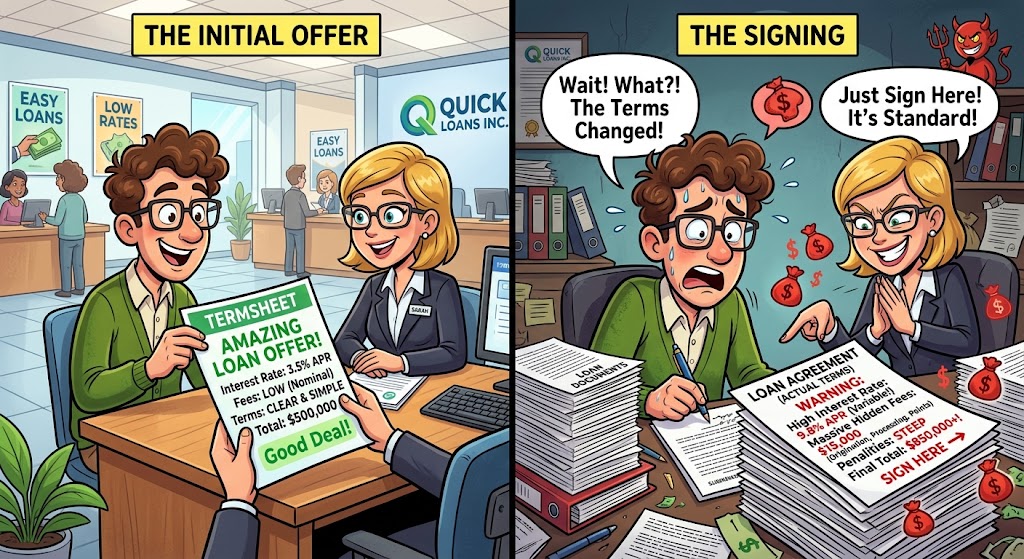
The irony.
I read a complaint from a lender today. Went something like this: "Brokers shotgun me too many deals". When I was a lender I, too, held this same complaint. Now that I'm a commercial loan broker, of course I wish borrowers shotgunned too many deals to me! But I digress.
When I did become a broker (out of post-merger necessity), I very quickly learned that brokers serve as essentially the human API equivalent to term matching in an opaque market. Some brokers actually try to keep up on where any given lender is on any given Tuesday, and the good ones are market makers in an industry with no standardization.
A shotgun spray is a micro-market and, to the credit of the lender who made that complaint above, it's a highly ineffective one.
The issue.
So why am I bringing up shotgunning deals in the context of retrades? Same root problem: The market is opaque, what's stated ≠ what executes, and there's no national standardization in reporting. So brokers (and borrowers) shotgun deals. There's no button to click to "buy" a set of terms. And YES.... good, hard working brokers or borrowers should read tear sheets and build execution context (and also yes. The good ones do), but it's not enough. Because as things currently stand, on any given Tuesday a lender might have accidently doubled their dose of SSRIs and agree to push a deal internally that falls a bit out of mandate. And so it continues.
The bond market got mandatory price reporting as early as the 30's, cusips in the 60's, and TRACE in 2002. Where's that for lending? Better question: What do the bond markets have that real estate lending doesn't? Four things:
- Industry, strategy and quality are categorized.
- Capital is widely KNOWN.
- Terms are widely KNOWN.
- Terms that actually TRADE are widely known.
The big one: 3 and 4 together. In the bond market, you know what the offered terms are. But more importantly, you know what the TRADED terms are. Cowboy bond brokers juicing spreads (the early bond market equivalent of CRE capital markets broker fees) died the second these two things lost their opaqueness and became compulsory to report to an information marketplace. It didn't just become a written rule to report. You'd literally get fined and could get sued if you didn't.
County-level reporting is disjointed, and there are literally over 3000 versions of this with little to no standardization of information. Ever gone into a county recording site? There's usually no API for that. And good luck tracking 3000 of those sites with bots. Without a federal recording state, there is no meaningfully consistent way to track the four answers that matter above – and that's on the premise that this information is consistently recorded. And it isn't.
Have solutions been attempted? Kind of. Twice. And both got challenged.
FinCEN's Residential Real Estate Rule became effective on March 1, 2026 and replaced the old geographic targeting orders with a nationwide framework, requiring title companies to collect and report private transaction details on residential transfers to entities and trusts to a national courier (via FinCEN). Limited in scope, but effectively a county → national reporting standard. And not 3 weeks after being introduced, Texas (of course!) vacated it. Good for lenders and brokers. Bad for borrowers.
CFPB 1071 is the closest thing to a mandated CRE loan-terms tape, since small-business credit sweeps in a lot of small-balance CRE-secured lending. Dodd-Frank ordered it in 2010. But the rule was challenged in multiple federal courts, delayed, and reconsidered, and the latest May 2026 rule narrows both the population of covered lenders and the scope of reportable transactions, eliminating a substantial portion of discretionary data fields and retreating to the statutory minimum. By how much? Now, only roughly 31 non-depository institutions (under 2% of non-depository small business lenders) are covered, and the new rule strips out data points including pricing and denial reasons. Private lenders escaped, and price came out. Good for lenders and brokers. Bad for borrowers.
So what's the solution?
If you're a lender or a broker, you probably think you don't want one. But given I clearly don't want any friends, I'll suggest one anyway. And -- kidding aside -- I pose a genuine question: Did the bond market shrink after regulation? Sit on that. In fact, what reporting standards arguably DID do was buy more confidence from the market itself, which incentivized even more issuance and investment and made the US more economically dominant on the global stage. So maybe… just maybe… better reporting could actually be a win/win/win for the good guys. Just a thought.
Meet PRIA and MISMO.
The infrastructure that already exists for 1 and 2 above.
PRIA: Property Records Industry Association. A membership of county recorders, title and escrow professionals, lenders, and the technology vendors who serve all of them. It has no statutory authority whatsoever. It writes standards anyway and states adopt them by reference because writing one from scratch is expensive and no legislator has ever wanted to litigate margin widths. Kentucky's (a deep red state) county clerks adopted PRIA formatting standards wholesale. Washington (a deep blue state) built its state eRecording standards on the PRIA foundation and concluded nothing needed to be added.
MISMO: Mortgage Industry Standards Maintenance Organization. It owns the data dictionary (the actual vocabulary for loan terms). And PRIA and MISMO are already alliance partners who build their standardized work products together.
So the plumbing exists. There is a structured document envelope already carrying recorded instruments, with (currently pruned) branches for grantor, grantee, property, parties, execution, and mortgage consideration to graft to. There are two standards bodies who already share a room. With PRIA, a private consortium that becomes bipartisan law in 37 states without a single floor vote. With MISMO, a food label, not a ban.
The limitations.
The recorded instrument doesn't contain the terms. A deed of trust gives you face amount, borrower, lender, and a legal description. The note isn't mandated to be recorded, and it never will be, because recording exists to give notice of an interest in land, not to publish a credit agreement. Spread, index, DSCR test, extension conditions, prepay, carveouts. None of it is in there.
So PRIA and MISMO only get you items 1 and 2 on my list above. Category and identifier. The boring foundation nobody gets rich building but some people get rich selling (pay gated data companies that turned on a few scrapers and APIs).
Items 3 and 4 are the ones that actually matter, but these have to come from somewhere else. And there's only one entity in this business that sees both the signed term sheet and the final closed terms, sits in the same file, and has zero economic interest in the number.
Escrow.
The settlement agent watched you sign the LOI at 300 over. The settlement agent watched you close at 375 over eleven days after the borrower went hard on the PSA. Nobody else in the transaction is positioned to observe that delta and indifferent to it. The lawyers get paid regardless. The brokers get paid to push the close. The lenders get paid more to retrade. PRIA already co-publishes with ALTA. And FinCEN, for all the litigation, already forced title companies to build reporting intake. The pipe is halfway constructed and pointed in the right direction.
Which brings me back to where I started.
Retrade isn't (always) character defect. It's often also a rational adjustment in a system that happens to reward it.
At 90 days to close the borrower has options. At 10 days to close he's got a deposit up, third-party reports paid, counsel engaged, and a hard closing date. His reservation value collapsed and the lender knows the exact day it collapsed. Manipulating a borrower or dragging them through the mud until their options are extinguished is an ethics problem (and I've seen the worst of the worst from the most unsavory characters in the industry in this regard). But there's a legitimate version, too. The appraisal came in light, a tenant on the rent roll doesn't exist, and the market can't cheaply tell the two apart.
To be clear, a better system does not mean that the retrade dies. But it does mean that it get's recorded. In fact, one could argue that a better system would make light of legitimate retrade spread, and in doing so would demystify the phenomenon altogether. It becomes a trusted given. For the worried lender who has had to make legitimate changes to their terms as new information became known, that means LESS "You told me one thing but did another!" So this goes both ways. A better system prices every lender as though they might retrade. Which means a term sheet conveys nothing about whether the deal closes at those terms. Which means something else has to certify execution.
That something is two things. One, it's a relationship. And right now, that relationship is a biased professional: A broker, an attorney, a capital markets seat that gets paid commissions. Two, it's capital execution. And right now... in many cases... who knows. Really. And maybe a market that knows that you have capital execution capability might not be such a bad thing. Because you're the good guy and want to make more good loans... right?
Retrade is the load-bearing wall holding up the entire intermediary layer, including mine as a broker. Make quoted-versus-closed compulsory and that wall comes crumbling down. The lenders who actually execute will be able to prove it, and will charge for it. Confidence gets PRICED. The good guys win. The ones who don't, or who favor extraction over legitimate adjustment will stop getting first look. And the only firms that lose are the ones whose value was never certification in the first place.
I'm aware of what I just argued for. I realize it's idealistic and, yes... nuanced. But better reporting and more standardization of information is not impossible. This isn't rocket science. Bad for lenders and brokers, and good for borrowers? Or good for GOOD lenders and brokers, and good for GOOD borrowers? I lean to the later on this one.
This industry is slow to adapt. There's just too much damn money in arbitrage for it to race to a logical solution. But it should. And you should.
Nobody (credible) ever said "less people win if we get more honest".
My 23 Billion Lesson
My 23 Billion Lesson
Read this if you want to cut token usage by up to 75%.
Let me be your guinea pig. I'm about halfway into what has developed into a massive undertaking that I have over a decade of deep domain expertise to conceptualize and very little of the technical skills to actually implement -- hence why I'm vibe coding, Reddit Foruming and YouTubing my way through it like a chimp on a bicycle.
What I'm building: A full CRE all-in-one Underwriting Suite. 23 Billion tokens. 1.3 Million lines of code deep (a real investment, mind you). The result that's unfolding: A full stack application with structure and governance guardrails that stitches both proprietary and open-source tooling with a schema and libraries that would make your CRM blush, AI import capabilities and best-in class IC-friendly analysis and auditing functions across all asset types, scenarios and across various modules and submodules covering operations (historical and proforma), development budgets and draw sizing, markets and comps, and institutional multi-lifecycle and complex stack capital structuring capability. It's cool. It's intuitive. It's user friendly. But it's not done yet.
But I digress. I was WELL past due for a comprehensive audit (PM me if you'd like the script I ran for this, courtesy of hours of my own research). So I ran one on my last 30 days of sessions. Here's what I found that will SAVE YOU MONEY. FYI keeping code and specs off of this so I don't get banned (or hacked), but feel free to slide into my DM's for nerd talk (prompt lines, scripts, system architecture, etc... happy to share):
1. The Lightbulb. AI has ADHD:
If you and I sit down for a coffee and I tell you my problems, my goals and what I'm working on, chances are (if you like me), you'll remember at least parts of that conversation -- and enough context to fill in the blanks the next time we get together.
AI does things differently. When you have that same coffee date with an LLM, it has to record the entire conversation. Each time you talk to that same LLM in a session (your "date"), before it responds, it has to play back the full recording of what you said before. In other words, every turn in a coding session replays the ENTIRE CONVERSATION. Turns out, that's expensive, but there are commands to fix that.
2. Marathon Sessions (the biggest cost):
- The issue: Auto Mode has a Yin and Yang. While you will never get anything done if you're forced to sit and hit "approve" 80 times in a session, mind the dangers of Auto Mode. And mind your usage of "Ultracode" in Claude or ultracode skills in Codex. You might THINK you're done (because YOU are), but if you have agents and tasks fanned out (as you should be doing -- consciously), your coding agents probably aren't. My audit returned an alarming finding. I ran one session for 21 hours straight AFTER my last prompt. Oops.
- What it costs: Every single exchange re-reads the entire conversation from the beginning. My average request was 435,000 tokens, and only 38,000 of that was actual setup. The rest was history. Cost grows roughly with the square of session length, so a wasted exchange early gets re-read hundreds of times. The longer the session, the more this can compound.
- The fixes: Your goals, your architecture, your schemas, your libraries, your rules: Should all be easily accessible in your repo docs for each new session to reference -- and should both grow and get trimmed over time. End sessions at natural boundaries and instruct the gates from the start. Mind "ultracode" (if using Claude Code): this will automatically fan out agents without you asking. This is cool. This also needs to be treated with care. Write a handoff note, check context to make sure you aren't breaking anything that shouldn't be turned off, clear work processes when you hit your gate safely, and start fresh in a new session on the next task. This will save you from data greedy little minions scouring your machine while you're away.
3. Redundant Prompts:
- The issue: I told agents the same thing more than twenty times in one case ("stop giving me this bad script to run. it doesn't work"). It kept getting it wrong.
- What it costs: 35 logged incidents of it taking an approach I'd already rejected. One misread instruction cost me >hour to unwind.
- The fix: Anything you've said twice belongs in a rules file ("put this in the 'constitution' or 'commandments' doc" etc.) the AI reads at the start of every session. A rule stated in chat dies with that chat.
4. No Automatic Checks:
- The issue: Nothing sat between the AI making a change and me noticing it broke something.
- What it costs: 70 self-inflicted bugs. My single largest source of friction, and most of them were mechanical: formatting artifacts, broken references, silent failures.
- The fix: A automated check that you put into your docs that runs after every edit. Mine would have caught most of those 70 in seconds instead of three exchanges later.
5. Hand-Verifications:
- The issue: I don't accept "it's fixed." I open the browser and check. That instinct was right and it caught real problems. But there's a better way.
- What it costs: Over 1,000 manual verification round trips, each one re-reading that 435,000-token history. My median response time was five minutes, and a lot of that was me personally auditing claims.
- The fix: Delegate verification to a separate cheap process that only checks (how YOU would) and never edits. Same rigor, fraction of the cost, and none of it clogs your main session.
6. Expensive Model Use (Despite Thinking Otherwise):
- The issue: When the AI spins up helper tasks and agents, they inherit whatever model you're using by default unless you set explicit instructions to the contrary.
- What it costs: I was running a frontier model to do the equivalent of searching for a filename
- The fix: One line of config per helper task. Cheap model for simple work, expensive model where being wrong really matters. Fable for heavy orchestration. Opus or even Sonnet for the cheaper writes. Think of it like any organizational hierarchy. Fable shouldn't be shoveling coal. It's sitting in the foreman's office. And to save face here, I'll add the caveat that I DID instruct this hierarchy, but only on the tasks and agents I KNEW about. I never explicitly instructed "ALL OTHER AGENTS AND TASKS". Just that simple addition would have saved me significant token cost.
7. Parallel Work in a Shared Space:
- The issue: In one example, I ran three full sessions at once against the same file.
- What it costs: A production outage. Broken builds. Duplicated stylesheets.
- The fix: Isolated workspaces, one per task. Standard practice in software, and I skipped it because I was moving too fast and am admittedly still learning some UI/UX basics.
8. Optimizing the Wrong Thing Entirely:
- The issue: My instinct on hearing "context is expensive" was to trim my instructions file. Everyone does this. But it's not enough.
- The measurement: My instructions were 1.4% of the cost. In fact, I should have been ADDING to and UPDATING it. All configuration combined was 5.8%. The actual work product, the code it wrote, was 7.6%.
- The fix: Trim your sessions, not your instructions.
THE AUDIT MATH
- 90% of token spend went to re-reading.
- ~40% of my volume went to correction rather than production.
- And 40-50% of my usage could also be attributed to bad gate etiquette: not setting the STOPPING place from the start correctly, or leaving AUTO idly running invisible agents that were fanned out by Ultracode automatically.
The estimate for fixing all of it: about a third fewer exchanges to the same output, and 60 to 75% lower cost.
If you're running these tools at any real scale, your instincts about where the waste lives are probably wrong. Mine were. By a lot. I assumed it was in my instructions and my model choice. And it was -- partly. But most of my waste ran on session lengths, fanned out agents acting rogue, and idle times. The efficiency paradox I slapped myself with: I was fanning out agents like a scrum master with a 30-man team, but they went rogue because I didn't give them simple bi-laws to follow ("don't get drunk at the water cooler" would have been a good start). Constitution: Created, but not properly minded. Lessons learned.
Happy to share more technical configs, prompts, skills or creator notes with anyone who wants them. We're all learning this stuff together. Comment or DM.
Loan Diligence: Box-Checking or a Rehearsal?
Loan Diligence: Box-Checking or a Rehearsal?
Whichever side of the deal desk you sit on, something in here is going to ruffle some feathers. Read it anyway. Sponsors will close on better terms. Lenders will close with better borrowers.
Let’s imagine for a second that you’re a sponsor of a deal that needs a loan. You got the term sheet, and now you’re at the fun part: “Needs List”, “Underwriting List”, “Underwriting Checklist”. You know, that long list of documents that was probably sent to you by some young kid sitting behind a desk who never bought, sold or built anything themselves. So what is it actually for?
- A. A full accounting of your project or investment that helps a prospective lender determine their risk, and therefore the leverage and price that they are willing to accept for that risk (oh… you thought that was already determined on the LOI? Sorry to break it to you…)
- B. A behavioral stress test of YOU
- C. A behavioral stress test of THEM
- D. All of the above
This is a Pass or Fail question. Pass, you get a smooth close. Fail, you don’t.
Of course, the answer is D. All of the above.
The diligence process is both a qualifier for the final structure and a rehearsal for the loan.
Underwriting is as much about you as it is about risk. And it’s as much about them as it is about you. Understanding this, and understanding not just what underwriters want to see but also how they want to receive that information, is almost as important (and sometimes more important) than the merits of the deal itself.
What the underwriting process tells your lender
1. Are you organized?
Does the package arrive complete and indexed, or does it trickle in across nine emails with filenames like “scan_final_v2(3)”? The file room is a preview of your draw requests, your competence (can you organize a file?) and your respect for the little guy (the analyst, the junior underwriter, the processor). Here’s a secret: more often than not, I’ve seen bad deals with good organization get better terms than good deals with bad organization.
Do your numbers tie? If the rent roll, T-12, and pro forma tell three different stories, the underwriter’s first job becomes reconciling you instead of underwriting you. Is it a lie? Is it incompetence? Is it laziness? That work gets priced.
2. Are you transparent?
Did the lien, the lawsuit, the cost overrun, the partner dispute come from you, or from the background search? Self-disclosed warts are underwriting items. Discovered warts are character findings.
One discovered omission converts every other document in the file from “accepted” to “verify independently.” That’s weeks of timeline and a permanent trust discount.
Do Not Lie.
3. Are you smart?
Can you answer the second question? Anyone can recite their own pro forma (if you can’t, then you definitely just answered this section… sorry). The tell is what happens one step down from this: why that absorption assumption, can you justify your OPEX ratio, and what breaks the exit?
Do you know your deal’s weaknesses before the underwriter names them? Do you believe it has any weaknesses? A sponsor who understands and volunteers the bear case and has an action plan for it reads as an operator and a problem solver. A sponsor who’s hearing it for the first time reads as a student in their own deal. Your lender is not your professor. Furthermore (and this is almost a universal reality) a sponsor who can get in front of any skepticism is one who can demand better terms. A sponsor who can’t is handing a lender a blank check. Reinforce the weaknesses with logical rationalization and contingency plans before they suck your wallet out through the holes they poke in your hull.
4. Are you responsive?
Turnaround on follow-ups is scored, whether anyone admits it or not (in fact, I argue in my credit matrix tool that this should be a credit box addition). Twenty-four hours reads as an operator with their arms around the project. Two weeks reads as a future servicing problem.
Silence gets interpreted, and never charitably. An unanswered question ages into an assumed problem, because the underwriter has to fill the gap with something, and they’re paid to fill it conservatively. Blank = bad.
When I underwrote files for a national construction lender, we had a saying: “If it’s not there, assume the worst” (this almost always applied to personal financial statements. For God’s sake. Send it). Now, there may be some things that can be weaved in as trust and process are built. For example, you don’t need to disclose on day 1 that 7 months ago you had a sub lien the property, sue you, and then the case got dismissed due to sub fraud. You do need to disclose if there is an ongoing major issue (like a case), and what you’re doing about it. Something that deserves an LOE (letter of explanation) or could be a binary deal killer is not something you should waste days, weeks or months of everyone’s time hiding.
5. Are you easy to work with?
When asked for something inconvenient, do you send it or litigate the request? Every negotiated document request is logged as a preview of covenant compliance conversations to come.
Do you treat the analyst as well as the MD? Underwriters compare notes. The sponsor who’s charming up and abrasive down gets written up, informally, in every credit discussion.
To the hard hitters who have been successful at plowing their way through deals with brash and cunning: yes, you’re loud, and scary, and smart. But that timidness or silence from that green analyst or originator on the other end of the line isn’t fear. It’s resentment brewing. And I assure you that gets priced in without a paper trail. Don’t be a dick.
If the answer to any of these is no, your otherwise good deal loses points. Er… I should say, probably gains points (in cost).
Everything above is really one question:
The underwriter is extrapolating from your best behavior to your behavior under stress, and the discount rate on that extrapolation is steep.
Retrades on leverage, price and covenants are unfortunately almost a given on any LOI that is a TBD (hint: they all are). Any seasoned operator knows and bemoans this.
Now. Of course retrading is not just a you problem. In the multi-trillion dollar RE lending industry, there is sadly a broad spectrum of business ethics, and where your lender sits on the “do what you say you’ll do” spectrum will determine if they treat retrading as a fee and yield extraction game (bad), or a reactive, fiduciary responsibility to their investors (fair).
What the underwriting process tells YOU about your lender
Speed and rhythm
How long from package delivery to first substantive follow-up? A desk that takes three weeks to open your file may also take three weeks to fund your draws. Yes, these are different departments, but response times should trickle down from leadership.
Are follow-up requests batched and organized, or do they arrive one at a time, drip-fed? Drip-fed questions usually mean nobody senior has actually read the file yet, unless they’re milking the behavioral stress test and/or slow-playing you until another loan pays off, which is a whole other issue.
Are the same questions being asked multiple times? If so, either they think you’re a liar (which you should probably address) or, more likely, they are not synced internally.
Probing that stops being underwriting
“What’s your total profit on this deal?” asked before terms are set, with no connection to sizing or cushion, isn’t risk analysis. It’s a fee calibration exercise or, worse, they’re already thinking beyond foreclosure. Legitimate lenders ask about margin to confirm you can absorb stress. Extractive lenders ask about margin to see how much of it is available for capture. Pay very careful attention to how this question, which itself can indeed be legitimate, is asked.
Watch for interest in your upside instead of your downside. An underwriter’s job is the left tail: what happens if costs run, sales slow, rates move. When the questions keep drifting to the right tail (your exit, your promote, your equity multiple), you’re not being underwritten. You’re being appraised (and yes, that’s meant to sound ominous).
Questions about your alternatives are a tell: “Who else are you talking to?” or “How quickly do you need to close?” early in diligence measure your leverage, not your credit. These are common, innocuous questions in their own right (and especially common of an eager young originator), but the lender who knows you have no fallback and a hard deadline also knows exactly when the retrade can arrive and how much it can take, so consider how you respond to this. Transparency in your process doesn’t have to mean showing your entire deck.
Requests for information with no underwriting purpose: your basis in other unrelated projects, your liquidity beyond the guaranty analysis, what you paid for the land years ago when it doesn’t bear on current value. Information asymmetry is negotiating power. Some desks collect it for the file. Some collect it for the closing table.
Quality of the questions
Are the questions specific to your deal, or generic list recycling? A lender who asks about your takedown schedule read the file. A lender who asks for documents you already sent did not.
Do questions get smarter as the process goes, or do they reset every call? Repeated questions mean turnover on the deal team, incompetence, or senior decision makers haven’t yet engaged.
Who shows up
Have you spoken to the actual credit decision-maker, or only the salesperson who issued the LOI? If credit never appears before the retrade does, the LOI was probably bait, and this could be a signal that they are in the extraction game.
Does the originator’s story match the underwriter’s questions? Daylight between the two means the deal was sold internally on different terms than you were quoted.
How they handle bad news
When diligence surfaces a wart, do they call to discuss it, or does a revised term sheet just show up? The first is a lender working the problem. The second is a repricing machine.
When terms move, is the explanation specific (name the finding, name the impact), or vague (“committee got uncomfortable”)? Specific explanations can be negotiated. Vague ones are extraction.
Structural tells
Is the deposit refundable, and against what milestones? Nonrefundable deposits paired with slow diligence is the fee-harvest business model in its purest form. Fortunately, this has become increasingly rare due to litigation catching up to the game, but it still happens. Keep an eye on the fine print, and make sure your deposit is refundable sans actual expenses (appraisals, third-party reports, etc).
Did the term sheet leave key items “TBD in documentation” or not addressed (covenants, reserves, guaranty scope)? Every TBD or omission of key features in the term sheet is a pre-authorized retrade.
Ask what percentage of their issued term sheets close on original terms. They won’t have the exact number. They probably won’t tell you even if they do (nor should you expect them to). How they react to the question tells you more.
Track record
Get borrower and advisor (if you trust them) references from deals that closed and one that didn’t. How a lender behaves when walking away is the cleanest read on the spectrum described above. But careful here in discerning between standard gripes and actual red flags (which this section addresses).
Where does the money actually come from: discretionary fund, warehouse line, syndication after signing? A lender who has to go find your money after the LOI isn’t retrading you by choice; they’re passing through someone else’s terms. This is a common model. Many lenders JV (participate with other lenders on a note) or table fund (they write terms then go find the note buyer, usually from a relationship pool), but they should be transparent about their process and the range of terms they can pool from.
Major takeaways
OK. So here are the takeaways. The LOI is a draft, organization often pays more than quality, disclose before discovery (and if something isn’t disclosed, the worst is assumed), reinforce weaknesses with pre-emptive answers and contingencies, underwriters are always extrapolating (whether they know it or not), protect your leverage, listen to how the questions are asked and answered, and don’t be a dick.
Happy closings.
The Case For Why Your Employee's Next Computer Should Be a $400 Chromebook
and why companies should pay more attention to gaming trends
The Case For Why Your Employee's Next Computer Should Be a $400 Chromebook

A quick disclaimer. I'm not a tech guy. I'm a private real estate equity and credit nerd. But I recently stumbled across a content ad for GeForce Now. It’s a service that lets subscribers cloud into RTX 5080 Blackwell-class GPUs (starting with a free service up to $20 per month) to run graphics-intensive games, requiring nothing more than an internet connection strong enough to stream Netflix. And yes (judge me all you like) I tried it, and I ran a game at higher graphic settings than a Playstation 5 could handle on my 3 year old workstation laptop.
Now before dismissing me entirely for a gaming analogy (yes yes... you are far too important to play games, we all know), remember that Nvidia started as a gaming GPU company. More importantly, this little detour illuminated something that still feels dim for many consumers, SMEs, and even regional enterprise cost centers: a clear, hands-on look at how compute (NOT just gaming compute) is being radically reshaped.
We all know AI runs in giant datacenters. We all know AWS exists. And with quantum computing on the horizon, it’s obvious none of us will have supercooled or laser-zapping quantum rigs that can hack China's satellites in our homes. Compute is becoming a utility. Yet consumers and SMEs aren't on the train yet, and companies and consumers still spend hundreds of billions every year on hardware and electricity they largely don’t need.
While headlines fixate on hyperscale AI builds, a quieter shift is happening under the surface. Cloud-based CPU/RAM/GPU horsepower is now accessible to almost anyone, and much of the infrastructure being deployed that will become obsolete for the latest AI may still have an extended life with this use case (take that, Michael Burry). This shift moves tech spend from capital expenditure (slow, depreciating, and perpetually behind Moore’s law) to operational expenditure that’s immediately deductible and far more flexible.
Platforms like Paperspace and AWS WorkSpaces/EC2 now provide enterprise-grade performance for cents on the dollar. Paperspace offers turnkey cloud-PCs starting at fractions of a penny per hour. AWS lets you dial up cores, RAM, and GPUs on demand.
The implications are everywhere. A&E firms no longer need to tether staff to expensive CPU, high RAM or the latest GPU laptops. Biotech labs can run protein-folding variants in parallel instead of overnight. Boutique hedge funds can burst into 256 GB of RAM to run Monte Carlos instantly. Regional insurers can compute like national carriers. Public schools can teach machine learning on Chromebooks because the real compute lives elsewhere.
Imagine a “Compute Turbo Switch” on your taskbar. You click it when needed, or IT auto-triggers service use with certain apps, and your cheap device hands the heavy lifting to a cloud workstation. Locally: low energy, quiet, efficient, light. Remotely: 64 cores, 256 GB RAM, or a high-end GPU that can process CAD files or large models 5-20x faster.
At scale, this reduces demand for rare-earth-heavy devices, shifts energy toward hyperscale efficiency, and accelerates the transition to compute-as-a-utility.
There are risks. Platform concentration, outages, geopolitical exposure. Guardrails matter: multi-cloud redundancy, sovereign compute options, zero-trust architecture. But the upside remains enormous. Higher efficiency drives higher output per unit of resource. Productivity rises. Waste falls. Innovation accelerates. The legacy model of every household and business burning silicon at 5% utilization is simply not sustainable.
Yes, some workloads still need local execution: ultra-low-latency trading, air-gapped defense systems, plant-floor automation, and certain regulated data environments. But those exceptions shrink every year. Moore’s law has effectively moved to the cloud. As orchestration improves and specialized accelerators proliferate, cloud-first becomes the default.
Which brings me to the obvious conclusion: My next endpoint might ACTUALLY be a $400 Chromebook. But the work itself? It’ll run on 256 cores and 512 GB of RAM. More research and trialing is needed, but my use case, the math is compelling.
Here’s a plausible three-year cost comparison (compound this for your enterprise):
So for most people, and most businesses, the real question isn’t “Can the cloud handle it?” It’s: Why are you still paying $2,000 every three years for your / your employee’s machines?
Stick Your Head in the Freezer
Why high-compute work scrambles your speech (and a two-minute reboot).
Stick Your Head in the Freezer

I know I'm not alone in this. Yesterday, I jumped from heavy modeling straight into a call and sounded like I'd just woken up from anesthesia, then (partially) "snapped awake" mid-conversation like someone with a split personality disorder. Truth is, I fumbled through that call big time. I short-circuited.
Sounding like you can't connect your brain to your mouth after high-compute work (modeling, coding, underwriting, design, legal/strategy chess) is completely normal. But good God, man (or woman)… take a walk or do some jumping jacks first. (Note to self.)
After shaking off that awkward conversation, I went down the "gotta know why" rabbit hole. All intuitive stuff, but if you want solutions, you first need to define causation.
My questions:
- Why are so many skilled operators bad at presenting themselves?
- Why do competent people often sound awkward or under-confident?
- What is the underlying CAUSE for the disconnect between high-compute tasks and verbal communication?
It's not that the entire engineer floor, lab or quant desk is on the spectrum. It's that high-compute work hogs the brain's metabolic budget (glucose, oxygen, ATP, dopamine) and pulls fuel away from language circuits like Broca's area and the temporal lobe. Working memory gets saturated, language networks downshift, neural rhythms stay in "logic mode," and half the subconscious is still running the previous task. Result: the thoughts are there, but the brain fumbles them on their way to the mouth.
It's like RAM on a PC. When one tab maxes out the system, switching doesn't free it immediately. The old processes are still running.
Elite operators think in structures, constraints, failure modes and contingencies. That's why the best problem-solvers are often the worst self-promoters. Their priority isn't "sound polished." It's "what facts matter for solving this?" In my case, half my brain was still stuck on: "How do I shift $11M from the pref slice to mezz and senior without nuking LP promote or failing DSCR screens?" None of that is linguistic.
So do what I didn't do (thanks, Andrew Huberman). You know the long-term stuff (sleep, diet, exercise, hydration; creatine is a game changer), but if you need a fast triage checklist to reboot your brain in under two minutes before a call or meeting, try these:
- Splash cold water or stick your head in the freezer
- Do some jumping jacks
- Shift your vision far away for 10 seconds
- Say one simple sentence out loud (to a person or a wall)
- Quick sip or snack for a glucose bump
And to all: keep this in mind next time a high-skill professional tied to a desk sounds a little… well… off. They're probably competent. They just didn't stick their head in the freezer before switching from calibrating models across thousands of dependencies or gaming out a high-stakes scenario to answering, "what makes you the right person for this assignment?"
The Polished Turd and The Revision Tax
and the risk of artificially expedited quality
The Polished Turd and The Revision Tax

What follows is an observation, not a law, though if it holds it could probably be coined as one:
Polish, speed and comprehensiveness are as much a liability as an asset in any work product built to earn a decision.
First, an admission. I, like most professionals now days, use AI to assist me in several aspects of my work, including my writing (and virtually all of my formatting). You ever get stuck on a thought, say for example… this one:
“Hey, you know that movie with the actress who acted in that show we like about the thing with the tall guy who acted in…”
We’ve all been there. AI is great at helping us remember the movie title. It’s fantastic at helping us fill in the gaps, scan, reduce, concentrate. But with this comes a byproduct of AI that is also eroding both our collective raw talent – and our wisdom. And how does one obtain either? Experience. How does one get experience? By doing the work.
A work product used to be a measure of whether the person presenting it had done the work, and a measure of the quality of that work. The early adoption of Excel didn't make us work less or think less: back-of-napkin handshake underwriting turned into 15-tab models and calculus-ridden macros. The internet didn't just democratize information: it created pay gates, teased us with knowledge, and widened the gap between who knows and who doesn't. Technology, holistically, never eliminated work or diluted the value of human thinking that went into that work. It almost always created more of both. AI does the opposite. It is the first advancement in the lineage of technology that ultimately reduces both work and thinking, and that is precisely the problem.
In simpler times: it was safe to assume that work and thinking went into an artifact, to assume the artifact represented the quality of that work and thinking, and to assume that the more complete and polished the artifact, the higher the quality of what that artifact represented. A presentation, a model, a memo, a data room, a paper: each one used to carry that signal, and fairly. There have always been exceptions: snake oil and misrepresentation have always existed. But the heuristic held without a broad challenge, across centuries and civilizations, until now.
Now that a polished artifact is producible with a fraction of the work and speed, it has changed how we should measure work and thinking. And not only how. With whom, when, and where.
This is becoming harder to ignore. And so is the cost of missing, inaccurate or changing information.
The higher the aesthetic of an artifact, the more complete the answers to the questions the audience would have asked, or the faster all of it arrives: the more dangerous the artifact can become.
There are two risks here, and they pull in opposite directions on the same artifact.
The first: polish accelerates trust and buy-in faster than substance can be verified or trust bonds can be built. An artifact delivered with the confidence, completeness, and professional sheen that AI can now manufacture, and delivered fast, earns buy-in before anyone has tested whether the salient truth underneath it holds. Every downstream party stakes more on the artifact at the moment it lands than they would have staked on a slower, scrappier version of the same information that progressed naturally, and with more touchpoints. Speed and polish do not just present the case. They risk pre-closing the audience on it, leading to false positives.
The second: facts change. Sometimes through bad faith, sure, but more often through the normal course of a deal, a market, or a project evolving. When the facts change, the artifact should change with them — as should the buy-in. But updating the story naturally gets perceived as walking back something that was received and accepted as finished. You are no longer presenting; you are revising. And every revision to a once-perfect artifact reads as a story that has changed, not a fact that has changed. Credibility can erode on revision itself (the "Revision Tax"), not just on error or deliberate misrepresentation.
So the artifact is punished twice. It is trusted too quickly on the way in, and if things change (they almost always do), it is distrusted too quickly on the way out. The faster and more polished it was at delivery, the wider both swings can actually get.
The compounding risk: by the time the gap between the artifact and the reality surfaces, the credibility cost is no longer linear. It degrades across every node that took the polish at face value, every "Yes!" that came before anyone tested the substance or left room for things to change. And it lands hardest on the person whose name is on the artifact.
With AI, we may have found the inflection point of human value in the artifact of work product itself. But this doesn't change two critical and not-mutually-exclusive facts: polished turds are still turds, and change is not necessarily a credibility or quality event.
SLOW DOWN.
Cockroaches, Panic, and the Private Credit Ecosystem
Cockroaches, Panic, and the Private Credit Ecosystem

This has been bothering me for months. There has been a lot of news cycle sensationalism being focused on private credit recently. Mostly bad.
Do roaches exist? Yes. But they are snacking on rotting strategies only. Any other harm to the rest of the healthy ecosystem caused by broader sentiment is simply a symptom of panic. And it is often where panic pollutes common sense where opportunity hides.
Private credit is itself a much broader ecosystem with strategies across a diverse landscape of industries, businesses, asset types and geographies.
Sometimes the stock market is kind to X industry. Sometimes it is kind to Y industry. Sometimes it is not kind at all, despite there still being well performing industries, businesses or asset types that fall with the tide of market sentiment.
Private Credit, Broad Credit and Private Equity — like the stock market — are diverse in strategies, industries, asset focuses, and markets. Susceptible to technological, political, economic and social shifts; not immune to broad sentiment.
The headlines around redemptions at groups like Tricolor Holdings, Blue Owl or Blackstone are not about your main street HVAC companies, townhouse developments serving low and middle income families, or bridge loans on real estate. Those industries have their own set of unique challenges and many of them have largely been working through them. Look at construction, for example. Exits were bumped out due to DSCR compression, but the underlying fundamentals (housing needs) lay largely intact or are market nuanced. Most institutional managers (take Blackstone, for example) manage diverse portfolios across several strategies, just as the Vanguards of the world spread themselves across the equity markets.
The redemptions being discussed are disproportionately tied to exposure in AI versus legacy software or software exposed businesses.
So why the fear? Because AI is making many of the business cases in the software model of old obsolete. Many private credit funds invested billions in that old model. Now we have a new model. To compound matters, many private credit funds got in front of this and invested in AI infrastructure. In some instances, however, they may have rushed in rather quickly, creating an oversupply of capital in a narrow focus. This can create more competitive (more aggressive — i.e. riskier) underwriting. And this, too, scares investors.
So was Jamie Dimon right about there being some cockroaches? Sure. But will the market figure it out? Probably. Is a Main Street focused business, industry or asset in the same risk profile across private credit exposure as a software company that hired 200 sales people and 50 developers in 2020 and sells subscriptions for a tool that converts PDF images into spreadsheets that a $20-a-month subscription to Claude will do better and faster? No.
OK that is all.
Behavior Tests Belong in the Credit Decision
Behavior Tests Belong in the Credit Decision
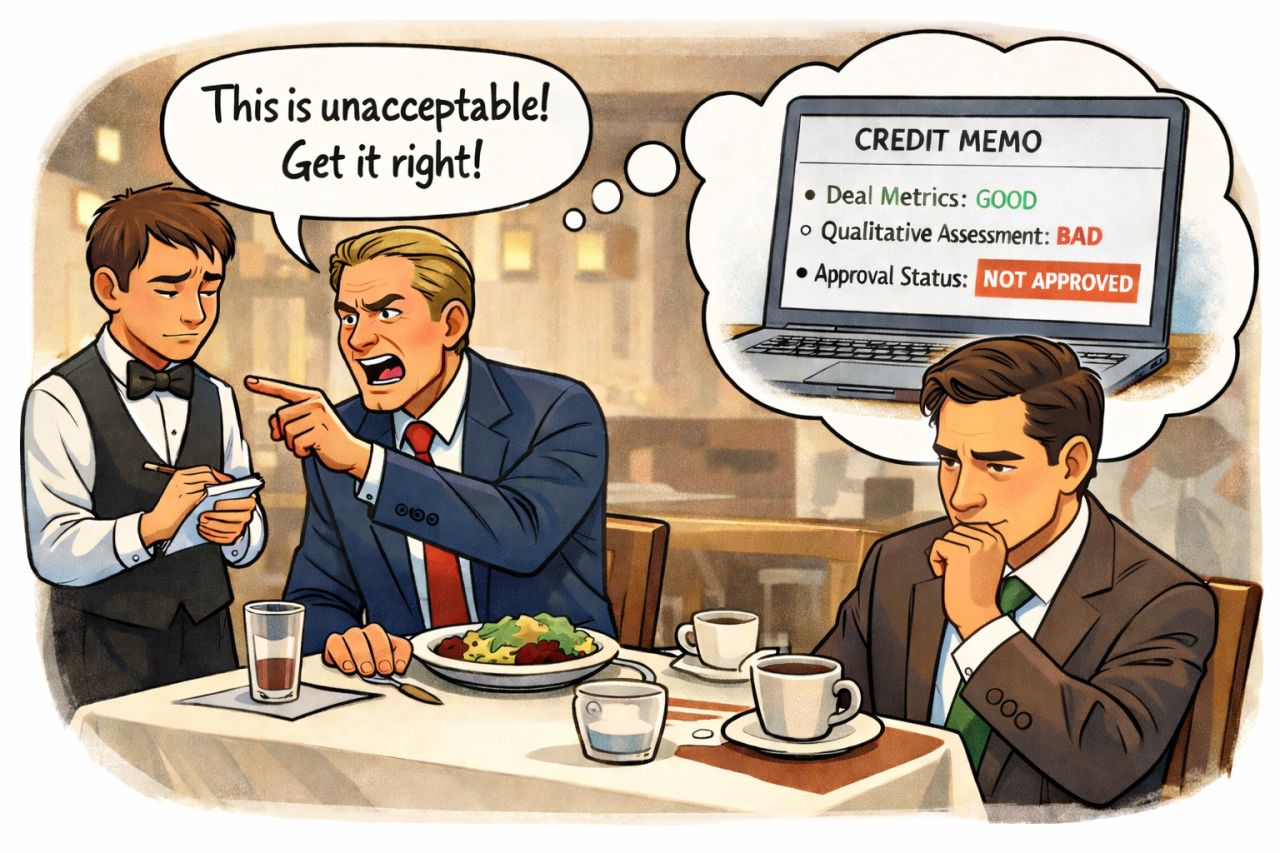
I can't stress enough the importance of behavior tests in funding decisions.
I've originated and underwritten billions of dollars of construction and transitional funding opportunities. Emphasis on "underwritten". Most of those deals never made it through the process. But many also did which – in hindsight – probably shouldn't have.
While this may seem controversial, believe me: if not already formalized, originators, LOs, underwriters, ICs and credit committees are already making behavioral judgements (and often poorly). In fact, appropriately formalizing the process would only serve to protect good sponsors more than punish them.
When I look back at the deals I originated and underwrote that actually survived COVID, rate shocks, refinancing freezes, and deal-specific failures, one of the most consistent patterns wasn't what the models said at closing. It was how the so-called intangibles weighed on performance.
Some objectively weaker deals (tighter leverage, thinner margins, more operational complexity, less experienced sponsors) performed materially better than "cleaner" ones. Why? Because the sponsors running them had the traits that matter when pressure stacks up: attention to detail, accountability, transparency, responsiveness, and the ability to stay constructive through trials.
Meanwhile, some of the best models I've seen fell apart because the people behind them couldn't handle friction or complexity. They were defensive. Evasive. Slow to disclose. Exhausting to work with. That doesn't show up in LTVs, or DSCRs, or debt yields, or ROAC. But it absolutely shows up in outcomes. One of the clearest early signals? The quality and completeness of the lender package: is it organized, cleanly labeled, easy to access and complete? This often reveals whether the sponsor respects people's time, understands how risk is evaluated (and thus what to look out for themselves), and is willing to be transparent before anyone is committed. An experienced underwriter or credit officer knows: for every missing answer, assume the worst.
Another: how does the sponsor treat others? Of course, this goes well beyond "manners". Have they missed past payments? Are they litigious? Did they fail to disclose? Do they do what they promise? The mistake underwriting teams make isn't ignoring behavior. Anyone acting as a good faith fiduciary will assess it mentally. The mistake is leaving it implicit, unstructured, and easy to override, especially in environments with allocation and fee pressure.
So instead of pretending these are "gut feels," it is far more effective and defensible to force structure onto the subjectives as a final approval step: scored and documented jointly by the people closest to the deal – origination, underwriting, processing. A consistent, team-assessed, final behavior test should always be part of the final approval process.
I believe the best way to do this is to incorporate behavioral characteristics into the credit model and risk pricing tools themselves. In Nabu, my proprietary credit matrix, portfolio synthesizing and auto-pricing DEMO, some behavioral considerations are hypothetically already considered, such as organization and response times, although state-by-state legal implications should be confirmed.
Effective Graphics: Months of Underwriting in One Image
Effective Graphics: Months of Underwriting in One Image
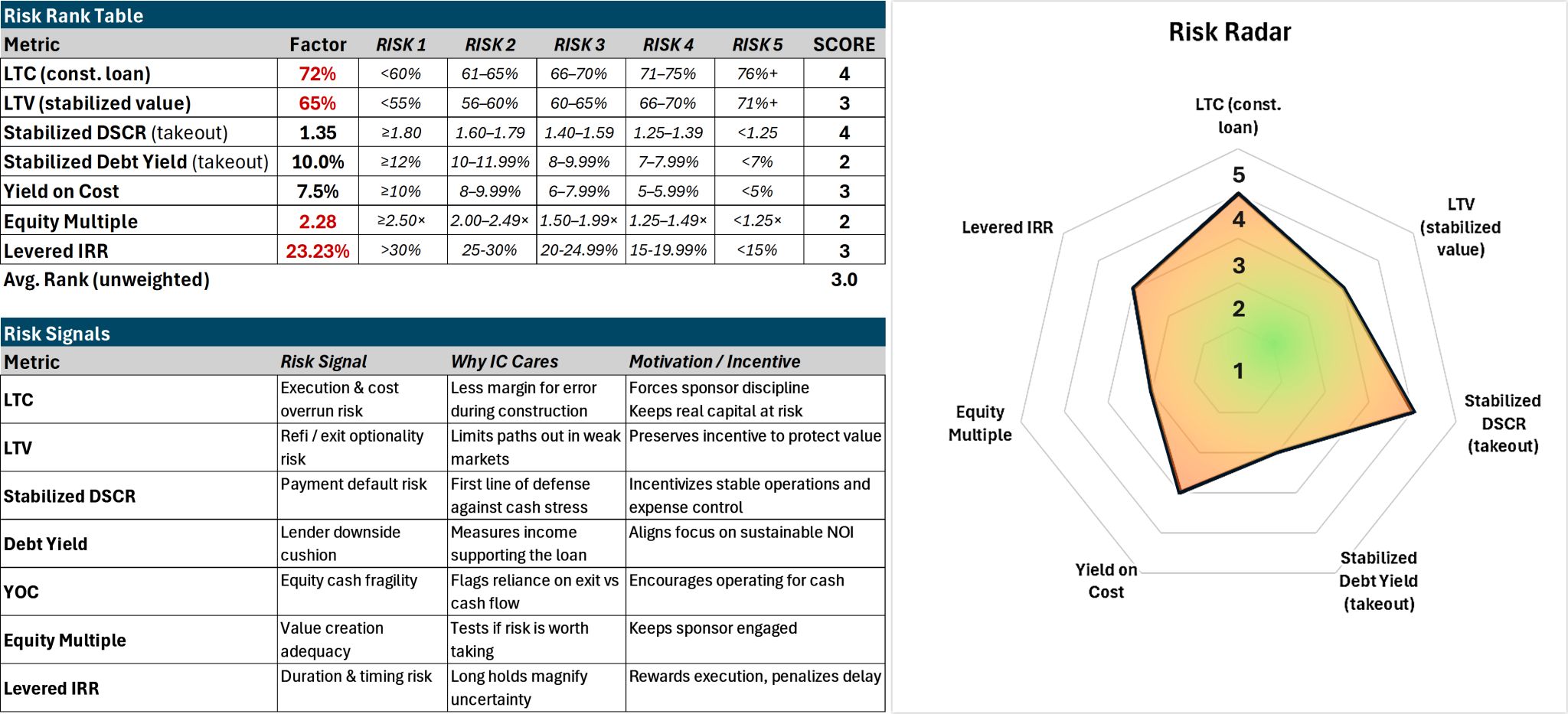
Effective graphics are more than aesthetic. Here is several months of construction loan underwriting distilled into one image — courtesy of a project I'm structuring (and still shaping… so don't put much weight on the actuals).
Investment committees should be doing this in some form or fashion.
The good ones already do, but it often takes months of proforma re-writes (Proforma Version 2.33, anyone?), memos, re-trades, sensitivity tables, and circular debate to finally land on these conclusions:
Where does risk actually sit, are performance metrics (Debt Yield, DSCRs, ROAC, etc.) commensurate, and how much confidence can be extracted from operator incentives?
By forcing leverage, coverage, yield, and equity outcomes onto a common or weighted risk scale (already done up-front in any good credit mandate leverage and pricing model, which in turn can be used to shape risk output buckets), it makes risk concentration and performance motivation visible immediately and exposes awkward cases where "fine on paper" really means "fragile IRL." It also helps surface areas of concern, misalignments and glaring errors early.
Risk isn't precise, but in most cases CAN be bounded and tested.
So what actually comes through in this snapshot? Let's assume the proforma and budget are already properly vetted, scheduled and comped (they are). The risk profile is coherent and internally consistent, which is the first hurdle. More importantly, the shape of the risk matches the asset. This is a front-loaded (new construction), operations-heavy, specialty lease type with a longer stabilization curve. Nothing here trips the "this doesn't make sense" alarm, but it does appear to edge high on the optimism scale.
Where an IC should really overweight stress here isn't macro assumptions or exit pricing, but operations over time. Not just whether the team can execute on construction, but whether they can execute consistently during lease-up and when stabilized without fatigue, slippage, or erosion in performance. That's why this framework is useful for me as an advisor. It gives me a clean way to tell the client where to focus and where to concede.
In a deal like this, modestly padding OPEX, being realistic on management costs, or slightly down-scaling lease or occupancy assumptions would only increase credibility, preserve incentive alignment mid-cycle, and reduce risk that operational misses compound into real problems later. This deal doesn't need value-cost engineering. It needs more operational slack and a realistically achievable, defensible business plan for lease-up and operations.
Your Tulip Is Wilting
Inflated assets, deflated reality, and can someone please tell Pollyanna there's a bear chasing her!?
Your Tulip Is Wilting

Jerome Powell was recently asked in a congressional testimony, "Sir, what did [the FED] get wrong in your pandemic response?" His response was subtle political genius:
"I probably would have been faster to do what I did anyways." — Jerome Powell, Chairman of the Federal Reserve
Ray Dalio has been warning us for years that we were entering a new global order — that inflation would destabilize asset prices and the U.S. would lose its global edge. His Economic Machine framework and Changing World Order thesis were mostly right — just a bit too early.
Timing, when reliant on human input, rarely follows logic.
Flashback to My Own Prediction
In an August 2024 piece titled "Long Lag for High-Risk Debt Margin Correction & Likelihood of Recession," I flagged the following:
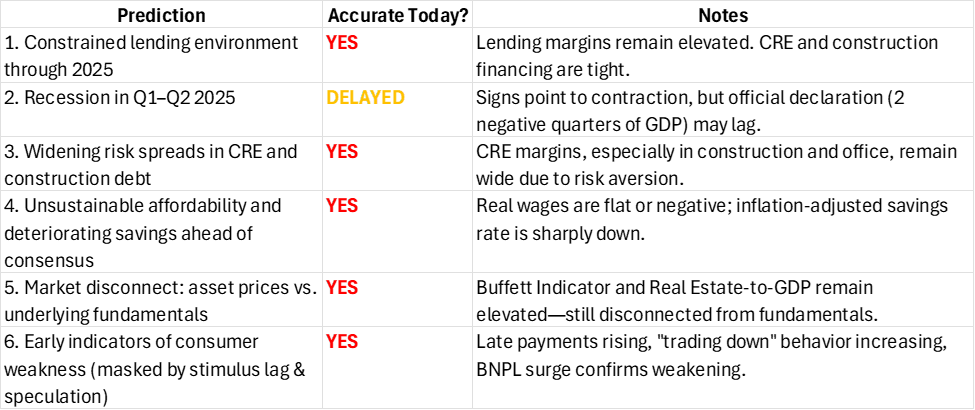
So Was I Wrong?
Like my much better pedigreed references above, the TIMING of my logic was off — but not wrong. Why? Because humans are irrational. Markets held their breath longer than logic would predict. But now, the signals are flashing red.
"Markets can remain irrational longer than you can remain solvent." — John Maynard Keynes
Worse, I underestimated:
- Posturing tariffs jacking up input costs
- Global devaluation of the USD
- Policy-fueled distortions lighting a match under an already fragile system
- Policy cuts (DOGE) and threats (immigration) to critical workforce
Observation (2025 Q3)
We're seeing asset prices ex-Real Estate continue to rise, while:
- Consumer affordability collapses
- Real wages stagnate
- Savings deteriorate
- Job mobility slows
- Input costs (tariffs) increase
- Optionality (also tariffs) decreases
This is not strength — it's a distortion.
If costs rise due to tariffs, labor, and subsidies, and if investors price in nominal earnings, then rising asset prices may be a hedge against currency debasement — not a sign of growth.
Investors aren't betting on productivity. They're betting on what assets will be worth in weaker dollars. They are betting that the loaf of bread they are investing in today will sell tomorrow for a wheelbarrow of cash.
Enter the Model
To test whether my thesis was early or incorrect, I created a first-principles diagnostic model — scoring key macroeconomic factors on a spectrum from contraction to expansion. I did NOT reference my initial predictions, instead stripping out the factors I weighed, added additional, and then backtested my previous prediction only once I scored the current climate.
Applied twice:
- August 2024: Score = +0.5 → (Artificial?) Stability
- Q3 2025: Score = –3.625 → Recessionary Contraction
The trend confirms it: we've exited the stability phase (however artificial that was, due to pandemic Black Swan revenge) and have seemingly entered a real contraction.
Model Inputs (15 Factors)
- Real Wage Growth
- Consumer Demand Trends
- Inflation-Adjusted Savings Rate
- Credit Usage
- Institutional Liquidity
- Commodity & Energy Prices
- Asset Inflation vs. CPI
- Retail Speculation
- Consumer Behavior Shifts
- Input Cost Pressures
- USD Strength
- Policy/Stimulus Behavior
- Real Estate Output to GDP
- Stock Market Cap to GDP
- Conference Board LEI
Each scored from –2 to +2 and weighted for macro impact. See the footnotes for data sources and expanded methodology.
Final Formula
Final Score = ∑(Fi × Wi) = –3.625 → Recessionary Contraction
Where Fi = score for factor i (scale: –2 to +2 based on economic signal) and Wi = weight for factor i (importance / macro influence).
Interpretation ranges:
- +6 and above — Inflationary Expansion: nominal asset growth, wealth gap rising
- +2 to +5.9 — Neutral Expansion: may mask structural imbalances
- –1 to +1.9 — Fragile / Artificial Stability
- –2 to –0.9 — Stagflation Risk
- Below –2 — Recessionary Contraction
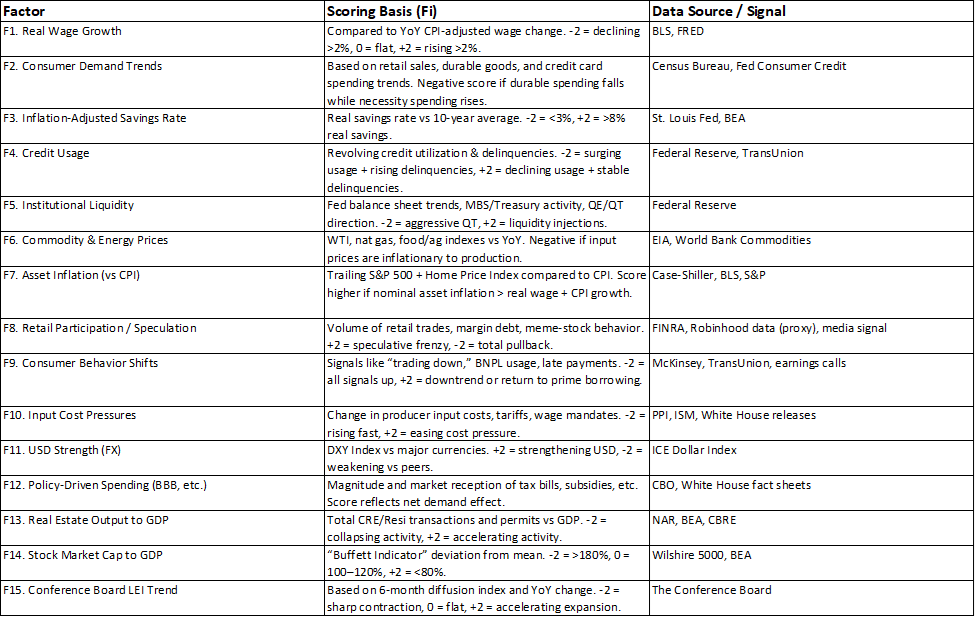
See sources and scoring methodology in the footnotes.
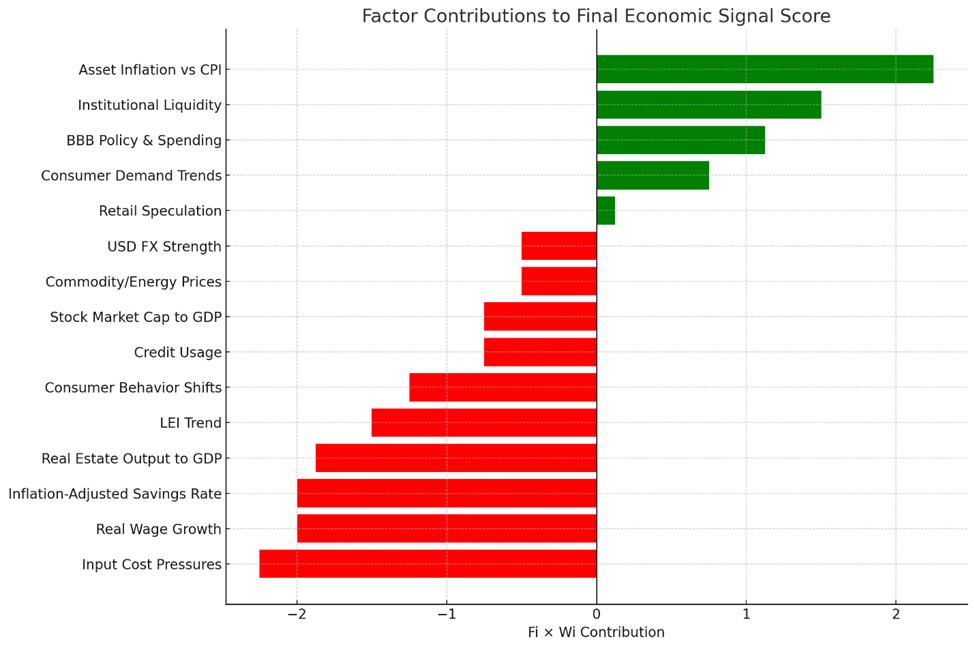
Scoring breakdown: (F1 – Real Wage Growth: –1 × 2.0 = –2.00) + (F2 – Consumer Demand Trends: +0.5 × 1.5 = +0.75) + (F3 – Inflation-Adjusted Savings Rate: –1 × 2.0 = –2.00) + (F4 – Credit Usage: –0.5 × 1.5 = –0.75) + (F5 – Institutional Liquidity: +1 × 1.5 = +1.50) + (F6 – Commodity & Energy Prices: –0.5 × 1.0 = –0.50) + (F7 – Asset Inflation vs CPI: +1.5 × 1.5 = +2.25) + (F8 – Retail Speculation: +0.25 × 0.5 = +0.125) + (F9 – Consumer Behavior Shifts: –1.25 × 1.0 = –1.25) + (F10 – Input Costs [Tariffs, Wages]: –1.5 × 1.5 = –2.25) + (F11 – USD FX Strength: –0.5 × 1.0 = –0.50) + (F12 – BBB Policy & Spending: +0.75 × 1.5 = +1.125) + (F13 – Real Estate Output to GDP: –1.25 × 1.5 = –1.875) + (F14 – Stock Market Cap to GDP: –0.75 × 1.0 = –0.75) + (F15 – LEI Trend: –1.0 × 1.5 = –1.50) = Final Score = –3.625
Real Estate & Equity Sector Outlook
Residential Real Estate: The Broken Ladder
Summary: We are witnessing an affordability collapse — not a housing boom. Mortgage rates remain elevated (~6.5–7.25%+), but wages have not kept up with inflation. The price-to-income and rent-to-income ratios have both broken historical norms. Even with limited housing supply, demand is stagnating — not because people don't want homes, but because they can't afford them.
Drivers:
- Affordability crisis: Monthly mortgage payments are up 60–100% since 2021 due to both price appreciation and rate hikes.
- Stagnant incomes: Real wages are flat to down YoY.
- Trapped supply: 60–70% of homeowners are locked into sub-4% mortgages. Few want — or can afford — to sell and re-buy.
- Rent pressure: Despite wage stagnation, rents remain elevated due to undersupply and institutional buy-to-rent strategies.
Outlook: Expect continued low transaction volume, squeezed margins for builders, and strong headwinds for first-time buyers. Policy intervention may try to stimulate demand (e.g. rate buydowns), but affordability won't return without price corrections or wage growth — neither of which seem imminent.
Commercial Real Estate (CRE): Propped Up, Not Prolific
Summary: Transaction volume is anemic. Valuations are suspect. Many deals are not happening because buyers and sellers are too far apart on cap rate expectations. Meanwhile, office remains in structural distress — particularly Class B and C — with permanent demand destruction.
Subsector breakdown:
- Office: Remote/hybrid work is now entrenched. Many Class B and C buildings are functionally obsolete. Lease roll-down risk and negative absorption plague urban office centers.
- Retail: Strong for essential and discount tenants (e.g. Dollar General, Aldi), but big-box and mall-based formats continue to struggle.
- Industrial: Still relatively healthy due to e-commerce and logistics demand, but cap rate pressure is emerging.
- Multifamily: Class A is overbuilt in some urban cores; Class B/C remains strong due to affordability demand. But rent growth is slowing, and expense pressures are rising (insurance, taxes, wage inflation).
- Hotels / Hospitality: High RevPAR in luxury/leisure markets, but softening in business travel segments. Financing remains tricky outside of top-tier brands.
Outlook: CRE debt maturities will drive forced sales and recapitalizations in H2 2025–2026. Expect price discovery via distress, especially in office, hotels, and overlevered multifamily projects.
Equity Market Outlook
Most at-risk sectors:
- Consumer Discretionary — Falling real wages, tighter credit, and high input costs are destroying margin and shrinking demand for non-essentials.
- Small Cap Growth — High debt sensitivity, low pricing power, and funding fragility make small caps especially vulnerable in a high-rate, low-liquidity world.
- Residential Construction — Builders face weak demand, affordability constraints, and volatile materials/labor pricing. Permits are declining.
- CRE REITs — Elevated cap rates, rising expense loads, and weak rent growth (especially in office/retail) are compressing NAVs and increasing debt rollover risk.
- Regional Banks — Exposure to CRE, tightening credit standards, and rising delinquencies in their loan books make them fragile. Deposit competition is eroding net interest margins.
Relatively hedged sectors:
- Mega-Cap Tech — Strong balance sheets, AI tailwinds, and global pricing power insulate against economic softness.
- Energy — Geopolitical instability, supply constraints, and low investment in upstream capacity support pricing. Cash flows remain strong.
- Defense — Rising global tensions, increasing government spend, and long-cycle contracts provide recession insulation.
- Class B Multifamily — Sweet spot for renters priced out of ownership or Class A luxury. High occupancy and stable rent collection.
- Retail (Discount/Value) — "Trading down" behavior favors brands like Dollar Tree, Walmart, and TJX. High turnover + pricing flexibility.
Strategic implication: The market isn't pricing risk correctly — it's pricing liquidity flow. Sectors that benefited most from free money and speculative froth are exposed. Sectors tied to real income and essential utility are gaining relative strength. Smart capital rotates from risk-on narratives to durable necessity — but the biggest risk is still the disconnect between asset prices and fundamental cash flows.
Disclaimer
Don't take market advice from me — I'm acronym-deficient and you're not paying me anyway. The views expressed are purely informational and unavoidably satirical. They do not constitute financial, legal, or investment advice. While the data is real, the bear chasing Pollyanna is metaphorical (for now). You should probably consult your financial advisor before making any investment moves — or shorting optimism. Honestly, your psychologist might prefer you keep the sunny outlook.
IMPORTANT NOTE: Written PRIOR to the creation of my Haruspex engine, which has since been revised slightly. For up to date methodology, please reference my Hobby Projects page (HARUSPEX).
Footnotes & Scoring Methodology
- F1 — Real Wage Growth (–1): Real average hourly earnings rose just 1.8% YoY (May 2024–May 2025), lagging core inflation. Source: BLS.
- F2 — Consumer Demand Trends (+0.5): Retail sales are steady, but growth is concentrated in discount/value channels, indicating trade-down behavior. Source: Census Bureau.
- F3 — Inflation-Adjusted Savings Rate (–1): U.S. personal savings rate remains near historic lows (~3.9%), far below pre-COVID levels. Source: FRED.
- F4 — Credit Usage (–0.5): Credit card balances and delinquency rates are rising, showing financial strain. Source: NY Fed.
- F5 — Institutional Liquidity (+1): QT pace has slowed and markets are pricing in rate cuts for 2025. Source: CME FedWatch.
- F6 — Commodity & Energy Prices (–0.5): Energy prices remain relatively stable, but food and input prices are still elevated. Source: BLS CPI.
- F7 — Asset Inflation vs. CPI (+1.5): S&P 500 is up ~18% YoY and home prices are climbing faster than inflation. Sources: S&P, FHFA.
- F8 — Retail Speculation (+0.25): Retail trading in meme stocks and crypto has ticked up modestly. Source: Vanda Research.
- F9 — Consumer Behavior Shifts (–1.25): Late payments and BNPL usage are rising; consumers trading down across categories. Sources: TransUnion, McKinsey.
- F10 — Input Cost Pressures (–1.5): New tariffs and labor mandates are raising production costs across industries. Sources: USTR, BLS PPI.
- F11 — USD FX Strength (–0.5): U.S. Dollar Index (DXY) is down ~4% YoY, reducing global purchasing power. Source: MarketWatch.
- F12 — BBB Policy & Spending (+0.75): The "Big Beautiful Bill" includes large-scale tax credits, but effects skew to asset holders. Source: CRFB.
- F13 — Real Estate Output to GDP (–1.25): Real estate remains ~13%+ of GDP despite contracting activity. Source: BEA.
- F14 — Stock Market Cap to GDP (–0.75): Buffett Indicator >180%, implying stock values far exceed GDP output. Source: Current Market Valuation.
- F15 — LEI Trend (–1.0): Conference Board LEI has declined 2.7% over the past six months. Source: The Conference Board.
Heuristic Traps Sabotaging Project Capitalization: Five Cognitive Pitfalls
Heuristic Traps Sabotaging Project Capitalization: Five Cognitive Pitfalls
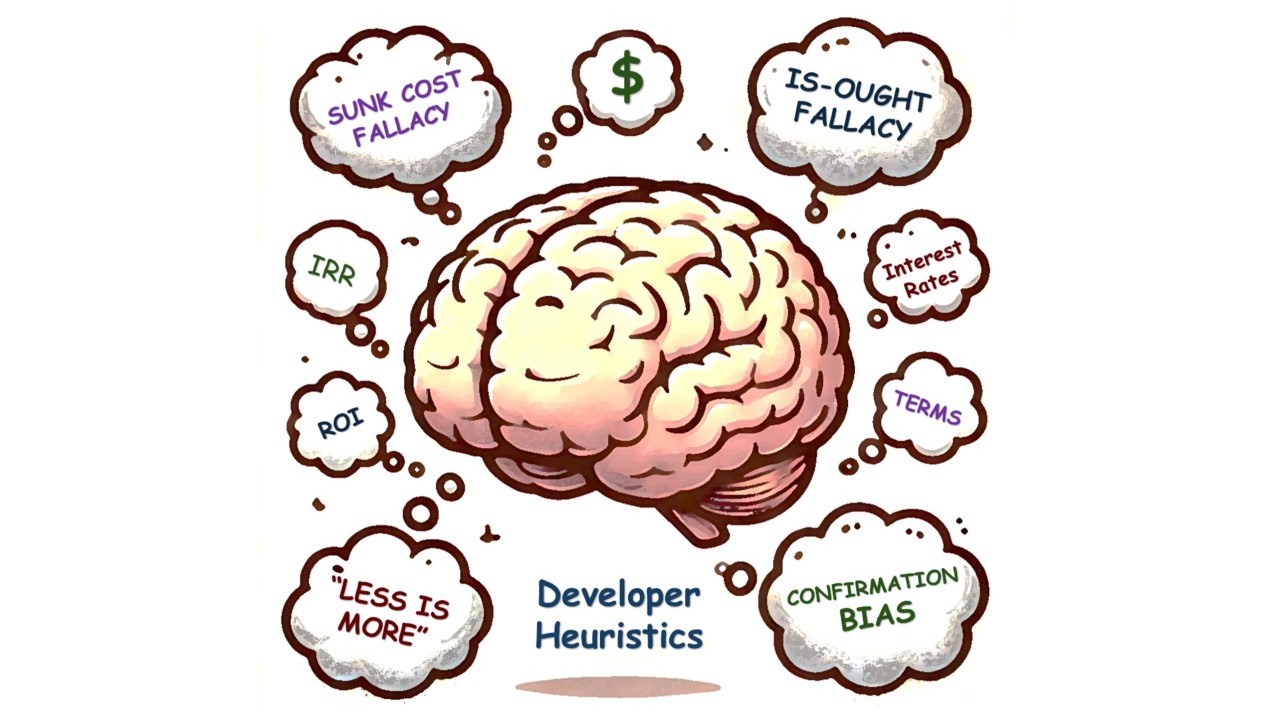
Introduction
As a bit of a disclaimer, I am NOT a behavioral psychologist. However, as a capital provider turned adviser who has funded and underwritten hundreds of real estate development projects, I have developed a certain understanding in my career of what leads developers to succeed in their capital raising efforts. With this, I have also developed an understanding as to why I, and most other capital providers and advisers, have seen so many clients fail to self-inflicted, confidence-confirming illusions; and to deceptions crafted by bad actors who exploit cognitive biases and fallacy traps to their zero-sum benefit.
All too often, I will lose prospective clients to these traps, only to have them re-engage with me months later. Worse, I have also seen many of these clients ultimately fail in their projects, months after rejecting the options and strategies that I initially laid out for them.
While indeed I recognize that some who do not return and who do not ultimately fail are able to find other solutions elsewhere, and that some even get "lucky" (there's always "that guy" on the golf course!), the reality is that the majority of those who get lost in the biases and fallacies that I outline below face significant economic setbacks. It is this frequent failure that underscores the importance of grounding decisions in solid, pragmatic analysis and peer insight.
We are all susceptible to the intricacies of human psychology, but if knowledge is power and introspection builds guardrails, then let this serve as a guide to some of the most common biases and fallacies that threaten to burn developers' time and money during the funding process:
1. Confirmation Bias
Confirmation bias is the tendency to search for, interpret and remember information in a way that confirms one's pre-existing, often optimistic beliefs or theories while disregarding contrary evidence.
Why developers fall into this bias
Underwriting proformas to attract investors and lenders often leads developers to subconsciously believe in their own assumptions, especially when facts give way to manipulated data over multiple iterations. This bias often blinds them to potential pitfalls (or sometimes even missed opportunity) and to ignore or miss entirely methods of adaptation.
Historical benefits (and why it's common)
Strong presentations that model and highlight the best outcomes can attract better capital by showcasing the most optimistic scenarios, appealing to investors' desires for high returns.
Examples
As a simple (and the most common) example, a developer might present a project with overly optimistic rental income or sale projections, leading to initial success in securing term sheets or even funding. However, if market conditions change and these projections are not met, the project could face financial distress, which is the overwhelming reason why so many capital providers are not lending right now (due to portfolios bloated with non-performing, over-levered loans that can't achieve an exit). Alternatively, the ascribing developer could spend months of underwriting with capital providers whose initial terms (often delivered by overly aggressive originators, many of whom exploit the sunk-cost fallacy), only to be re-traded or even ultimately rejected by credit and investment committees.
The danger
Believing only the best outcomes without considering potential risks can lead to significant financial losses and project failures. It can also damage credibility with investors and lenders when the reality does not match the projections.
What can be done about it
Developers should adopt a more balanced approach by incorporating conservative assumptions and stress-testing their projects against various adverse scenarios. This will allow them to see the pitfalls, and to get in front of them with solutions or contingencies. Seeking diverse opinions and engaging in robust market and budget analysis can help counteract confirmation bias.
2. Availability Bias
Availability bias differs from confirmation bias in that it assumes the importance or likelihood of events based on how easily they come to mind. It relies on the perceived "tried and true" method of doing things (as opposed to confirmation bias, which relies on seeking to reinforce assumptions or desires). This can lead to decisions that are influenced more by recent experiences or memorable methods of doing things rather than a comprehensive analysis of all relevant information and an adapted approach.
Why developers fall into this bias
Developers often rely on their own proven project underwriting methodologies and past experiences when modeling cost and performance projections. This approach can cause them to overlook or misunderstand how capital partners might underwrite the same project. By relying on their own "proven" methods, developers may miss out on key considerations that are critical to investors and lenders.
Historical benefits (and why it's common)
Using familiar methodologies can streamline the underwriting process and provide confidence in projections. Developers may feel assured by their track record and the ability to quickly produce proformas that have previously attracted interest. This reinforcement makes it easy to continue relying on the old assumptions and methods without questioning their applicability to different partners.
Examples
A developer might use their own tried-and-true method for projecting top-line performance based on past projects in similar markets. However, a capital partner may evaluate the project differently, considering factors like future market trends, alternative income sources or alternative exit contingencies, or different risk assessments, and will likely be focused on THEIR position on the waterfall, or THEIR own IRR (applicable to both equity and credit partners). This disconnect can lead to a failure in securing funding or unexpected re-evaluations during the approval process.
The danger
Relying solely on one's own methodologies can result in misalignment with capital partners, leading to rejected proposals or unfavorable terms. This bias can cause significant delays and financial losses if the project's assumptions are not aligned with the investors' criteria. It can also damage relationships with capital providers, making it harder to secure funding in the future.
What can be done about it
To mitigate availability bias, developers should seek first an understanding of the various ways capital providers analyze risk and calculate value, and they should model all stakeholder performance on the waterfall. This involves asking the questions: What are their internal requirements? How will THEY underwrite their own risk and reward? How will THEY make money? Do they just look at LTV and LTC? DSCRs? IRR, ROI, ROE, MOIC, ROAC — and how do they calculate? At what point in time? With what assumptions? Are they themselves making an unlevered return or a levered one? Are they in it for the fees, the carries? Are they transactional, or relationship oriented?
If trust can be built (or already is), then consult with the capital partner directly. Ask them what they're modeling to and you may even be able to fill in the gaps they don't disclose. In many cases, consulting financial advisers or consultants who have expertise in how different capital providers evaluate their own risks and rewards, and with a significant portfolio themselves of past transaction comps, may be a more appropriate (and safer) way to bridge the knowledge gap and provide insights that align the developer's projections with the expectations of capital partners.
By adopting a more holistic approach and considering the diverse methodologies of capital partners, developers can create more robust and attractive projects and proposals that align with the expectations and requirements of their investors and lenders.
3. Hume's Law
Definition
The is-ought fallacy, or "Hume's Law", occurs when someone assumes that because something is (or has been) a certain way, it ought to be (or continue to be) that way. It conflates descriptive reality (what is) with prescriptive or normative belief or assertions of (what ought to be). I'm not just talking to the old timers here, either. 2019 underwriting is not just an apple to an orange to current underwriting. It's in a different food group entirely.
Why developers fall into this fallacy
When a project is started based on historical data and assumptions, developers may adopt stale assumptions and fail to adapt to changing market conditions and costs.
Historical benefits
Using historical data and assumptions can simplify decision-making and provide a clear roadmap based on past success and proven models, which is useful in stable markets.
Examples
A project might have been started years ago with the assumption that there is a strong market for luxury amenities, such as imported Italian tiles. However, if the market shifts and the premium paid for such high-end features diminishes, continuing with these assumptions can lead to financial overextension.
The danger
Failing to adapt to changing market conditions can result in cost overruns and reduced profitability. It can also lead to the development of projects that do not meet current market demands.
What can be done about it
Regularly reassess the project's assumptions and adapt to current market realities. Conduct market research to understand current trends and preferences, and be willing to pivot strategies to align with the present demand.
4. The "Less Is More" Fallacy
Definition
The "less is more" fallacy occurs when individuals believe that simpler solutions are always better, even in complex situations that require detailed analysis and multifaceted approaches.
Why developers fall into this fallacy
Good entrepreneurs are action-takers and often believe that quick, simple solutions will suffice. They tend to take the loudest and simplest solutions presented to them, usually those from street brokers promising fast delivery.
Historical benefits
Simplified decision-making can, indeed, lead to quicker actions and can be beneficial in straightforward situations where over-analysis could hinder progress.
Examples
A developer might quickly accept a term sheet from a broker or an originator that promises high loan-to-cost (LTC) ratios and low-interest rates without fully understanding the terms or potential pitfalls. For example, a full interest reserve on an interest rate of 10% may be promised, when in reality this interest reserve is being fully capitalized as a day-1 disbursement, equating to an effective yield of 12% or higher. The term sheet from the OTHER lender that outlines a 12% interest rate on an accruing basis, while they may also offer other more favorable terms (such as better extension terms or guaranty requirements), may then be overlooked. Furthermore, these initial, more aggressive (on paper) offers almost always get re-traded, leading to worse conditions.
5. The "Sunk Cost" Fallacy
Definition
The sunk cost fallacy occurs when individuals continue investing in a project due to the amount already invested, rather than evaluating its current viability.
Why developers fall into this fallacy
Developers often fall into this trap when they have already invested significant time and resources into a project, leading them to continue despite negative indicators.
Historical benefits
Persisting with a project can sometimes lead to eventual success, especially in cases where initial challenges are overcome through perseverance.
Examples
A developer might continue self-funding and accumulating debt on a project that no longer pencils due to changing market conditions, simply because of the significant time and capital already invested.
A developer may accept re-traded terms after spending months in underwriting so as to not have to start the process again with another capital partner.
The danger
This fallacy can lead to escalating commitments towards failing projects or non-accretive terms, resulting in greater financial losses and wasted resources.
What can be done about it
Establish clear criteria for evaluating project viability and term sheet offers at each stage. Regularly reassess the project's financial health and be willing to halt or divest from unviable projects. Keep your options open, and don't just adopt the first best offer. If the current state of the markets or available options "breaks" the project, consider other arrangements, such as a sale or stepping aside as the core sponsor and JV'ing with another group. Decision-makers should focus on prospective costs and benefits rather than past expenditures, and they should consider when to leave their emotions and egos at the door.
Conclusion
Navigating the complexities of capital markets requires vigilance against the biases and fallacies that otherwise threaten to distort decision-making. By recognizing and mitigating these cognitive pitfalls, developers can make more informed, resilient decisions, eliminate time waste and allow themselves to realize new solutions and contingencies for better project results and more favorable terms from capital providers.
Fostering one's own personal approach, and a team environment built around continuous reassessment and flexibility, will better position projects for success in an uncertain economic landscape. Seek the right questions and seek advice, partners and advisers who won't just tell you what you want to hear, but will help to define and navigate hurdles and adapt to reality.
Recommendations
- Incorporate conservative assumptions: Developers should adopt a more balanced approach by incorporating conservative assumptions and stress-testing their projects against various adverse financing scenarios. This helps reveal potential pitfalls and allows for proactive solution development. If higher debt proceeds are incorrectly assumed to be obtainable from the start, for example, then valuable time will be wasted that could be spent securing and crafting profitable strategies with alternative capital.
- Engage with capital partners early: Collaborate with potential investors and lenders early in the process to understand their specific underwriting criteria and risk assessment methodologies. This ensures alignment and reduces the risk of misaligned expectations.
- Consult financial professionals: Work with experienced financial advisers or consultants who have expertise in how different capital providers evaluate projects and underwrite terms. Not only will this open up more options as they seek competing prospects, but will help you to bridge knowledge gaps, align your projections with the expectations of investors and lenders, and gain profitable solutions to working within the parameters of available capital arrangements.
- Regularly reassess market conditions: Regularly reassess the project's assumptions and adapt to current market realities. Continually conduct market research to understand trends and preferences, stay in-tune with capital market terms and be willing to pivot strategies to align with present product demand and available capital.
- Thoroughly underwrite capital options: Thoroughly underwrite potential capital options as a credit or investment committee would, rather than relying solely on initial offers from brokers or originators. Engage in detailed analysis and explore multiple financing structures to ensure the best possible terms.
- Evaluate project viability objectively: Establish clear criteria for evaluating project viability and term sheet offers at each stage. Regularly reassess the project's financial health and be willing to halt or divest from unviable projects, focusing on prospective costs and benefits rather than past expenditures.
For more information or to explore possible capital solutions for your own projects, please feel free to contact me directly.