The Mathematical Case for (Actual) Creative Stretch Financing
e.g. bifurcated debt/equity strategy in commercial real estate
The ‘don’t like math’ version
CRE doesn’t have a debt crisis. It has a capital crisis.
The CRE debt model is antiquated. And for many scenarios right now, it’s not working. But debt allocators have access to capital. They are also the best positioned behind the sponsor to understand an asset, are familiar with it, and have already laid the infrastructure that flexibility can gain from.
One solution to the CRE Capital Crisis: FUND SOME OF THE EQUITY, TOO.
Look. I get it (I think). It’s a new mandate. Lenders aren’t set up to structure a position on a waterfall (this is a terrible excuse). There are additional legal layers (also a terrible excuse). Maybe the investors don’t like it. Uh huh. But much of this can be solved with harder and smarter work – something I thought most finance professionals were sadomasochistically drawn to. And as for investors, investors also don’t like 100% of their capital tied up in NPLs that can’t redeem, either.
There IS a better way, and while I’m seeing SOME mold to the new realities of this market, most aren’t. And excuse me for venting a bit, but this is incredibly frustrating. Most fund managers are good sales people. Hence, they are able to raise funds. Hence, they are the ones out allocating said funds. But if the market, economy, and the times are all changing, then those who don’t adapt will fail. Longer-horizon underwriting and exit strategies do not have to be an all-or-nothing proposition. Structurally, bifurcated solutions can offer more flexibility, better risk mitigation and more upside. So why aren’t we seeing more of this being offered? No but seriously. Asking because maybe I’m stupid. But I digress. Here’s the math.
The Commercial Real Estate Capital Stack Problem
If we strip it down to the variables (key at bottom of article):

In human talk:
- Deficit & Rigidity: Total capital commitments (∑ cᵢ) fall short of 100% funding (1.0), while the Debt and Sponsor tranches are hit by strict upper expansion limits (ε₁, ε₂).
- Financial Impasse: The cost of debt (RDebt) AKA interest rates and/or fees breaches maximum underwriting limits (θUW) OR outpaces the asset’s net cashflows available for debt payments, making further standard debt impossible. If DSCR backtests break, leverage is constrained on traditional single-tranche debt.
- Squeeze: Unspecified flexible capital variables (𝒳), such as Mezz, Pref or LP capital, face infinite scaling pressure (∞) to fill the void. These solutions are hard to source, structure and commit, and require redundant or new origination, underwriting and legal resources.
Solution 1 (the old way): External Intervener (third-party capital)

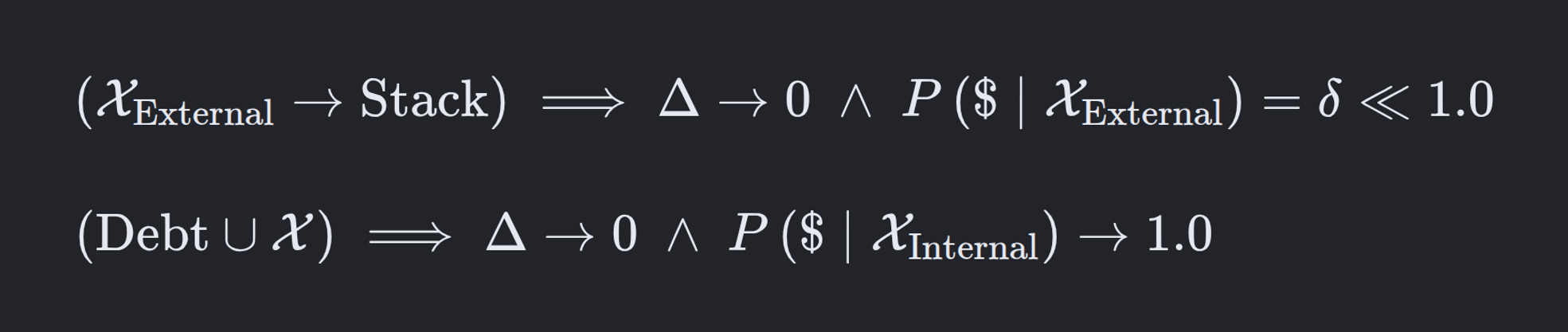
- The Math: The probability of securing dollars from a third-party stranger (𝒳External) is equal to delta (δ), which is substantially less than 1.0.
- The challenges: Newly introduced frictional drag > 0: structural re-underwriting, zero historical data comfort, intercreditor battles, and heavy due diligence requirements.
Solution 2 (the better way): Internal Structural Integration (The “One-Stop Shop”)

- The Math: The conditional probability (P) of securing capital, given that the provider is already the inside Senior Lender (𝒳Internal), approaches certainty (1.0). They already know the asset and have approved a comfortable traditional debt structure with the underlying underwriting.
- The challenges: Knowledge, skill, effort and buy-in.
Key
- cᵢ: Individual contribution percentage of party i to the capital stack.
- 1.0: 100% of required project funding.
- Δ: The funding gap or deficit.
- Debt / Sponsor: Core structural tranches.
- ε₁, ε₂: Small, rigid upper bounds limiting further contribution from Debt and Sponsor.
- RDebt: The effective interest rate/cost of debt (current phase or next lifecycle).
- θUW: The maximum allowable interest rate threshold permitted by underwriting standards.
- NOI: Net Operating Income (net proceeds of the asset available to service the debt).
- 𝒳 / 𝒳External: The unconstrained variable/set of external or intermediate funding solutions required to fill the gap.
- ∞: Infinite funding pressure / capital shortfall.
- ∑: Summation.
- ∧ / ∨: Logical “AND” / Logical “OR”.
- ⟹: Logical implication (“Therefore, it follows that...”).
- ∪: Set Union (the pairing, bundling, or co-provision of entities).
- ➔: Operational approach (“reduces down to / injected into”).
What “actual” stretch looks like (and why it isn’t happening)
Stretch financing, as it’s mostly marketed right now, is senior debt at a higher LTV and a higher coupon. That isn’t creative. It’s the same single-tranche note with the problem moved up the stack, and it fails the same DSCR backtest for the same reason.
Actual stretch is bifurcated on day 1. The lender writes the senior at the leverage and coupon the underwriting already supports, then fills some or all of the remaining gap with a second position – pref, co-invest, a participation, whatever the deal needs – priced for the risk it takes and paid out of the waterfall and the exit, not out of debt service that already doesn’t pencil. Managed efficiently: Same underwriting package. Same counsel, same closing, same servicer. The sponsor gets certainty of execution and one counterparty instead of an adversarial party with an intercreditor. The lender gets upside and more exit flexibility on their debt on an asset it was already underwriting.
Back to the math: P($) becomes the lender’s own decision. Δ closes on infrastructure that already exists instead of infrastructure a counterparty has to build. 𝒳 becomes a line item. Fees, carry and brand all benefit.
So why isn’t it happening? Because the fund docs say “debt.” Because LPs signed up for a current coupon, not a waterfall. Because originations gets paid on volume and credit committee gets paid on not being wrong. Because "less is more". All of that is legit. None of it is scripture. Worst of all: a lender sitting on a maturity with no takeout is already holding equity risk. It’s just holding it as an NPL. Any upside they DO extract comes with a cost: reputationally, legally, and ethically. Pref with a waterfall isn’t a new risk. It’s a better-priced version of the position they already have, or would have in a foreclosure.
The capital is there, and it's on the desk of the people who know the asset better than any new third-party. The only open question is whether debt allocators are able to, or DO, the work to deploy it, or keep waiting for the market to correct... or for the sponsors of all the deals they would have otherwise funded to pull rabbits out of hats. And how's the magic show going?