Heuristic Traps Sabotaging Project Capitalization: Five Cognitive Pitfalls
Introduction
As a bit of a disclaimer, I am NOT a behavioral psychologist. However, as a capital provider turned adviser who has funded and underwritten hundreds of real estate development projects, I have developed a certain understanding in my career of what leads developers to succeed in their capital raising efforts. With this, I have also developed an understanding as to why I, and most other capital providers and advisers, have seen so many clients fail to self-inflicted, confidence-confirming illusions; and to deceptions crafted by bad actors who exploit cognitive biases and fallacy traps to their zero-sum benefit.
All too often, I will lose prospective clients to these traps, only to have them re-engage with me months later. Worse, I have also seen many of these clients ultimately fail in their projects, months after rejecting the options and strategies that I initially laid out for them.
While indeed I recognize that some who do not return and who do not ultimately fail are able to find other solutions elsewhere, and that some even get "lucky" (there's always "that guy" on the golf course!), the reality is that the majority of those who get lost in the biases and fallacies that I outline below face significant economic setbacks. It is this frequent failure that underscores the importance of grounding decisions in solid, pragmatic analysis and peer insight.
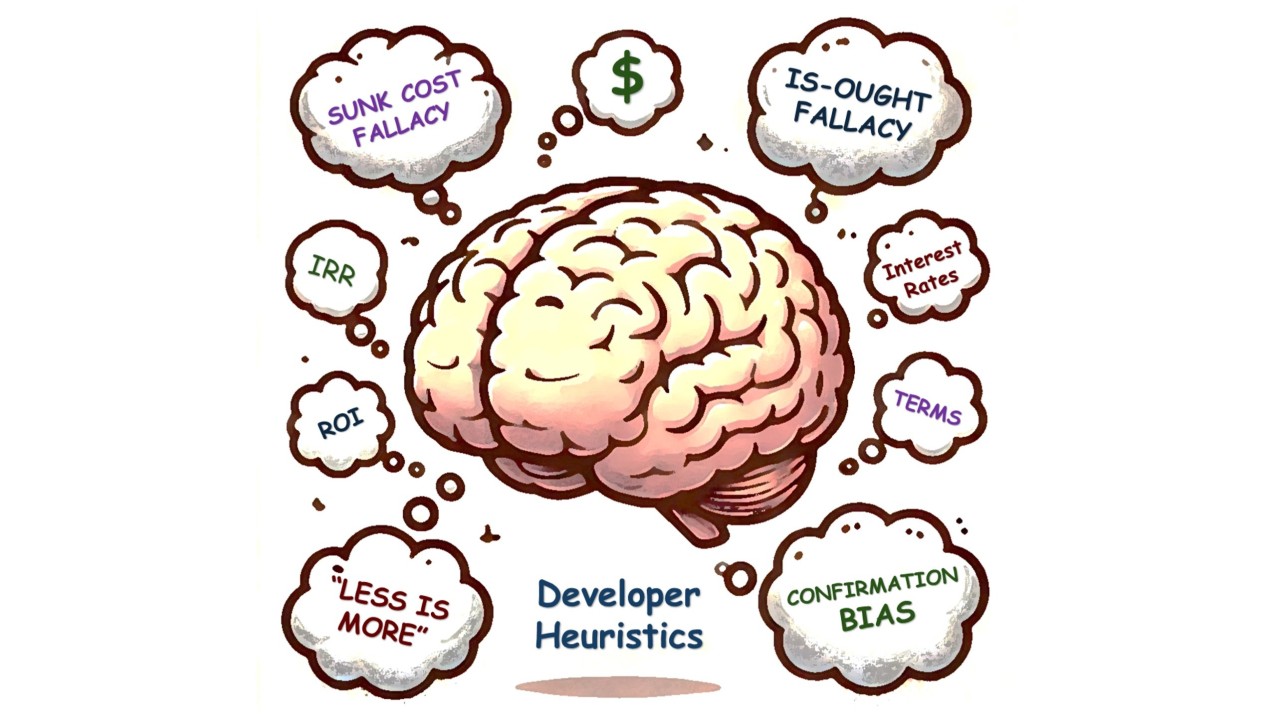
We are all susceptible to the intricacies of human psychology, but if knowledge is power and introspection builds guardrails, then let this serve as a guide to some of the most common biases and fallacies that threaten to burn developers' time and money during the funding process:
1. Confirmation Bias
Confirmation bias is the tendency to search for, interpret and remember information in a way that confirms one's pre-existing, often optimistic beliefs or theories while disregarding contrary evidence.
Why developers fall into this bias
Underwriting proformas to attract investors and lenders often leads developers to subconsciously believe in their own assumptions, especially when facts give way to manipulated data over multiple iterations. This bias often blinds them to potential pitfalls (or sometimes even missed opportunity) and to ignore or miss entirely methods of adaptation.
Historical benefits (and why it's common)
Strong presentations that model and highlight the best outcomes can attract better capital by showcasing the most optimistic scenarios, appealing to investors' desires for high returns.
Examples
As a simple (and the most common) example, a developer might present a project with overly optimistic rental income or sale projections, leading to initial success in securing term sheets or even funding. However, if market conditions change and these projections are not met, the project could face financial distress, which is the overwhelming reason why so many capital providers are not lending right now (due to portfolios bloated with non-performing, over-levered loans that can't achieve an exit). Alternatively, the ascribing developer could spend months of underwriting with capital providers whose initial terms (often delivered by overly aggressive originators, many of whom exploit the sunk-cost fallacy), only to be re-traded or even ultimately rejected by credit and investment committees.
The danger
Believing only the best outcomes without considering potential risks can lead to significant financial losses and project failures. It can also damage credibility with investors and lenders when the reality does not match the projections.
What can be done about it
Developers should adopt a more balanced approach by incorporating conservative assumptions and stress-testing their projects against various adverse scenarios. This will allow them to see the pitfalls, and to get in front of them with solutions or contingencies. Seeking diverse opinions and engaging in robust market and budget analysis can help counteract confirmation bias.
2. Availability Bias
Availability bias differs from confirmation bias in that it assumes the importance or likelihood of events based on how easily they come to mind. It relies on the perceived "tried and true" method of doing things (as opposed to confirmation bias, which relies on seeking to reinforce assumptions or desires). This can lead to decisions that are influenced more by recent experiences or memorable methods of doing things rather than a comprehensive analysis of all relevant information and an adapted approach.
Why developers fall into this bias
Developers often rely on their own proven project underwriting methodologies and past experiences when modeling cost and performance projections. This approach can cause them to overlook or misunderstand how capital partners might underwrite the same project. By relying on their own "proven" methods, developers may miss out on key considerations that are critical to investors and lenders.
Historical benefits (and why it's common)
Using familiar methodologies can streamline the underwriting process and provide confidence in projections. Developers may feel assured by their track record and the ability to quickly produce proformas that have previously attracted interest. This reinforcement makes it easy to continue relying on the old assumptions and methods without questioning their applicability to different partners.
Examples
A developer might use their own tried-and-true method for projecting top-line performance based on past projects in similar markets. However, a capital partner may evaluate the project differently, considering factors like future market trends, alternative income sources or alternative exit contingencies, or different risk assessments, and will likely be focused on THEIR position on the waterfall, or THEIR own IRR (applicable to both equity and credit partners). This disconnect can lead to a failure in securing funding or unexpected re-evaluations during the approval process.
The danger
Relying solely on one's own methodologies can result in misalignment with capital partners, leading to rejected proposals or unfavorable terms. This bias can cause significant delays and financial losses if the project's assumptions are not aligned with the investors' criteria. It can also damage relationships with capital providers, making it harder to secure funding in the future.
What can be done about it
To mitigate availability bias, developers should seek first an understanding of the various ways capital providers analyze risk and calculate value, and they should model all stakeholder performance on the waterfall. This involves asking the questions: What are their internal requirements? How will THEY underwrite their own risk and reward? How will THEY make money? Do they just look at LTV and LTC? DSCRs? IRR, ROI, ROE, MOIC, ROAC — and how do they calculate? At what point in time? With what assumptions? Are they themselves making an unlevered return or a levered one? Are they in it for the fees, the carries? Are they transactional, or relationship oriented?
If trust can be built (or already is), then consult with the capital partner directly. Ask them what they're modeling to and you may even be able to fill in the gaps they don't disclose. In many cases, consulting financial advisers or consultants who have expertise in how different capital providers evaluate their own risks and rewards, and with a significant portfolio themselves of past transaction comps, may be a more appropriate (and safer) way to bridge the knowledge gap and provide insights that align the developer's projections with the expectations of capital partners.
By adopting a more holistic approach and considering the diverse methodologies of capital partners, developers can create more robust and attractive projects and proposals that align with the expectations and requirements of their investors and lenders.
3. Hume's Law
Definition
The is-ought fallacy, or "Hume's Law", occurs when someone assumes that because something is (or has been) a certain way, it ought to be (or continue to be) that way. It conflates descriptive reality (what is) with prescriptive or normative belief or assertions of (what ought to be). I'm not just talking to the old timers here, either. 2019 underwriting is not just an apple to an orange to current underwriting. It's in a different food group entirely.
Why developers fall into this fallacy
When a project is started based on historical data and assumptions, developers may adopt stale assumptions and fail to adapt to changing market conditions and costs.
Historical benefits
Using historical data and assumptions can simplify decision-making and provide a clear roadmap based on past success and proven models, which is useful in stable markets.
Examples
A project might have been started years ago with the assumption that there is a strong market for luxury amenities, such as imported Italian tiles. However, if the market shifts and the premium paid for such high-end features diminishes, continuing with these assumptions can lead to financial overextension.
The danger
Failing to adapt to changing market conditions can result in cost overruns and reduced profitability. It can also lead to the development of projects that do not meet current market demands.
What can be done about it
Regularly reassess the project's assumptions and adapt to current market realities. Conduct market research to understand current trends and preferences, and be willing to pivot strategies to align with the present demand.
4. The "Less Is More" Fallacy
Definition
The "less is more" fallacy occurs when individuals believe that simpler solutions are always better, even in complex situations that require detailed analysis and multifaceted approaches.
Why developers fall into this fallacy
Good entrepreneurs are action-takers and often believe that quick, simple solutions will suffice. They tend to take the loudest and simplest solutions presented to them, usually those from street brokers promising fast delivery.
Historical benefits
Simplified decision-making can, indeed, lead to quicker actions and can be beneficial in straightforward situations where over-analysis could hinder progress.
Examples
A developer might quickly accept a term sheet from a broker or an originator that promises high loan-to-cost (LTC) ratios and low-interest rates without fully understanding the terms or potential pitfalls. For example, a full interest reserve on an interest rate of 10% may be promised, when in reality this interest reserve is being fully capitalized as a day-1 disbursement, equating to an effective yield of 12% or higher. The term sheet from the OTHER lender that outlines a 12% interest rate on an accruing basis, while they may also offer other more favorable terms (such as better extension terms or guaranty requirements), may then be overlooked. Furthermore, these initial, more aggressive (on paper) offers almost always get re-traded, leading to worse conditions.
5. The "Sunk Cost" Fallacy
Definition
The sunk cost fallacy occurs when individuals continue investing in a project due to the amount already invested, rather than evaluating its current viability.
Why developers fall into this fallacy
Developers often fall into this trap when they have already invested significant time and resources into a project, leading them to continue despite negative indicators.
Historical benefits
Persisting with a project can sometimes lead to eventual success, especially in cases where initial challenges are overcome through perseverance.
Examples
A developer might continue self-funding and accumulating debt on a project that no longer pencils due to changing market conditions, simply because of the significant time and capital already invested.
A developer may accept re-traded terms after spending months in underwriting so as to not have to start the process again with another capital partner.
The danger
This fallacy can lead to escalating commitments towards failing projects or non-accretive terms, resulting in greater financial losses and wasted resources.
What can be done about it
Establish clear criteria for evaluating project viability and term sheet offers at each stage. Regularly reassess the project's financial health and be willing to halt or divest from unviable projects. Keep your options open, and don't just adopt the first best offer. If the current state of the markets or available options "breaks" the project, consider other arrangements, such as a sale or stepping aside as the core sponsor and JV'ing with another group. Decision-makers should focus on prospective costs and benefits rather than past expenditures, and they should consider when to leave their emotions and egos at the door.
Conclusion
Navigating the complexities of capital markets requires vigilance against the biases and fallacies that otherwise threaten to distort decision-making. By recognizing and mitigating these cognitive pitfalls, developers can make more informed, resilient decisions, eliminate time waste and allow themselves to realize new solutions and contingencies for better project results and more favorable terms from capital providers.
Fostering one's own personal approach, and a team environment built around continuous reassessment and flexibility, will better position projects for success in an uncertain economic landscape. Seek the right questions and seek advice, partners and advisers who won't just tell you what you want to hear, but will help to define and navigate hurdles and adapt to reality.
Recommendations
- Incorporate conservative assumptions: Developers should adopt a more balanced approach by incorporating conservative assumptions and stress-testing their projects against various adverse financing scenarios. This helps reveal potential pitfalls and allows for proactive solution development. If higher debt proceeds are incorrectly assumed to be obtainable from the start, for example, then valuable time will be wasted that could be spent securing and crafting profitable strategies with alternative capital.
- Engage with capital partners early: Collaborate with potential investors and lenders early in the process to understand their specific underwriting criteria and risk assessment methodologies. This ensures alignment and reduces the risk of misaligned expectations.
- Consult financial professionals: Work with experienced financial advisers or consultants who have expertise in how different capital providers evaluate projects and underwrite terms. Not only will this open up more options as they seek competing prospects, but will help you to bridge knowledge gaps, align your projections with the expectations of investors and lenders, and gain profitable solutions to working within the parameters of available capital arrangements.
- Regularly reassess market conditions: Regularly reassess the project's assumptions and adapt to current market realities. Continually conduct market research to understand trends and preferences, stay in-tune with capital market terms and be willing to pivot strategies to align with present product demand and available capital.
- Thoroughly underwrite capital options: Thoroughly underwrite potential capital options as a credit or investment committee would, rather than relying solely on initial offers from brokers or originators. Engage in detailed analysis and explore multiple financing structures to ensure the best possible terms.
- Evaluate project viability objectively: Establish clear criteria for evaluating project viability and term sheet offers at each stage. Regularly reassess the project's financial health and be willing to halt or divest from unviable projects, focusing on prospective costs and benefits rather than past expenditures.
For more information or to explore possible capital solutions for your own projects, please feel free to contact me directly.