Let's Talk About Retrades
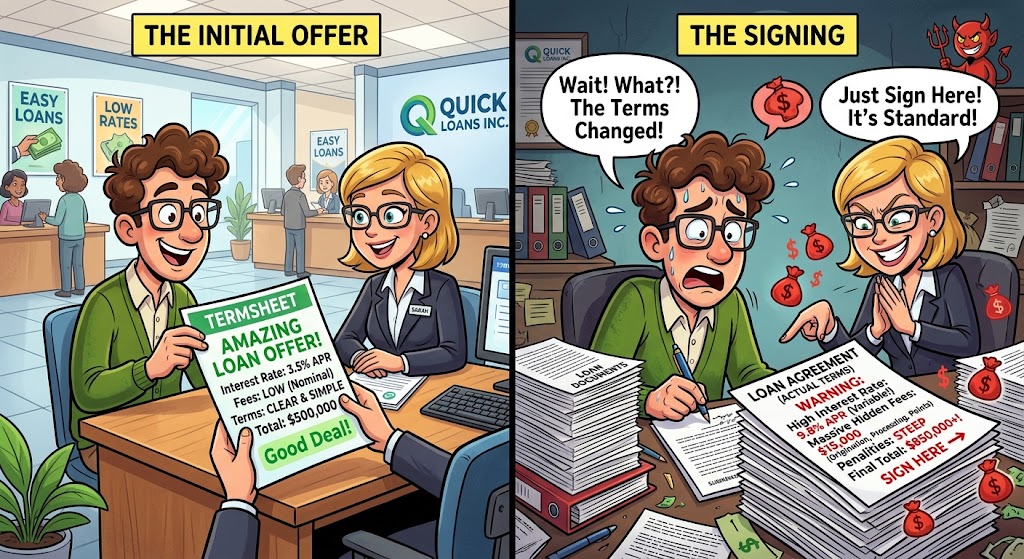
The irony.
I read a complaint from a lender today. Went something like this: "Brokers shotgun me too many deals". When I was a lender I, too, held this same complaint. Now that I'm a commercial loan broker, of course I wish borrowers shotgunned too many deals to me! But I digress.
When I did become a broker (out of post-merger necessity), I very quickly learned that brokers serve as essentially the human API equivalent to term matching in an opaque market. Some brokers actually try to keep up on where any given lender is on any given Tuesday, and the good ones are market makers in an industry with no standardization.
A shotgun spray is a micro-market and, to the credit of the lender who made that complaint above, it's a highly ineffective one.
The issue.
So why am I bringing up shotgunning deals in the context of retrades? Same root problem: The market is opaque, what's stated ≠ what executes, and there's no national standardization in reporting. So brokers (and borrowers) shotgun deals. There's no button to click to "buy" a set of terms. And YES.... good, hard working brokers or borrowers should read tear sheets and build execution context (and also yes. The good ones do), but it's not enough. Because as things currently stand, on any given Tuesday a lender might have accidently doubled their dose of SSRIs and agree to push a deal internally that falls a bit out of mandate. And so it continues.
The bond market got mandatory price reporting as early as the 30's, cusips in the 60's, and TRACE in 2002. Where's that for lending? Better question: What do the bond markets have that real estate lending doesn't? Four things:
- Industry, strategy and quality are categorized.
- Capital is widely KNOWN.
- Terms are widely KNOWN.
- Terms that actually TRADE are widely known.
The big one: 3 and 4 together. In the bond market, you know what the offered terms are. But more importantly, you know what the TRADED terms are. Cowboy bond brokers juicing spreads (the early bond market equivalent of CRE capital markets broker fees) died the second these two things lost their opaqueness and became compulsory to report to an information marketplace. It didn't just become a written rule to report. You'd literally get fined and could get sued if you didn't.
County-level reporting is disjointed, and there are literally over 3000 versions of this with little to no standardization of information. Ever gone into a county recording site? There's usually no API for that. And good luck tracking 3000 of those sites with bots. Without a federal recording state, there is no meaningfully consistent way to track the four answers that matter above – and that's on the premise that this information is consistently recorded. And it isn't.
Have solutions been attempted? Kind of. Twice. And both got challenged.
FinCEN's Residential Real Estate Rule became effective on March 1, 2026 and replaced the old geographic targeting orders with a nationwide framework, requiring title companies to collect and report private transaction details on residential transfers to entities and trusts to a national courier (via FinCEN). Limited in scope, but effectively a county → national reporting standard. And not 3 weeks after being introduced, Texas (of course!) vacated it. Good for lenders and brokers. Bad for borrowers.
CFPB 1071 is the closest thing to a mandated CRE loan-terms tape, since small-business credit sweeps in a lot of small-balance CRE-secured lending. Dodd-Frank ordered it in 2010. But the rule was challenged in multiple federal courts, delayed, and reconsidered, and the latest May 2026 rule narrows both the population of covered lenders and the scope of reportable transactions, eliminating a substantial portion of discretionary data fields and retreating to the statutory minimum. By how much? Now, only roughly 31 non-depository institutions (under 2% of non-depository small business lenders) are covered, and the new rule strips out data points including pricing and denial reasons. Private lenders escaped, and price came out. Good for lenders and brokers. Bad for borrowers.
So what's the solution?
If you're a lender or a broker, you probably think you don't want one. But given I clearly don't want any friends, I'll suggest one anyway. And -- kidding aside -- I pose a genuine question: Did the bond market shrink after regulation? Sit on that. In fact, what reporting standards arguably DID do was buy more confidence from the market itself, which incentivized even more issuance and investment and made the US more economically dominant on the global stage. So maybe… just maybe… better reporting could actually be a win/win/win for the good guys. Just a thought.
Meet PRIA and MISMO.
The infrastructure that already exists for 1 and 2 above.
PRIA: Property Records Industry Association. A membership of county recorders, title and escrow professionals, lenders, and the technology vendors who serve all of them. It has no statutory authority whatsoever. It writes standards anyway and states adopt them by reference because writing one from scratch is expensive and no legislator has ever wanted to litigate margin widths. Kentucky's (a deep red state) county clerks adopted PRIA formatting standards wholesale. Washington (a deep blue state) built its state eRecording standards on the PRIA foundation and concluded nothing needed to be added.
MISMO: Mortgage Industry Standards Maintenance Organization. It owns the data dictionary (the actual vocabulary for loan terms). And PRIA and MISMO are already alliance partners who build their standardized work products together.
So the plumbing exists. There is a structured document envelope already carrying recorded instruments, with (currently pruned) branches for grantor, grantee, property, parties, execution, and mortgage consideration to graft to. There are two standards bodies who already share a room. With PRIA, a private consortium that becomes bipartisan law in 37 states without a single floor vote. With MISMO, a food label, not a ban.
The limitations.
The recorded instrument doesn't contain the terms. A deed of trust gives you face amount, borrower, lender, and a legal description. The note isn't mandated to be recorded, and it never will be, because recording exists to give notice of an interest in land, not to publish a credit agreement. Spread, index, DSCR test, extension conditions, prepay, carveouts. None of it is in there.
So PRIA and MISMO only get you items 1 and 2 on my list above. Category and identifier. The boring foundation nobody gets rich building but some people get rich selling (pay gated data companies that turned on a few scrapers and APIs).
Items 3 and 4 are the ones that actually matter, but these have to come from somewhere else. And there's only one entity in this business that sees both the signed term sheet and the final closed terms, sits in the same file, and has zero economic interest in the number.
Escrow.
The settlement agent watched you sign the LOI at 300 over. The settlement agent watched you close at 375 over eleven days after the borrower went hard on the PSA. Nobody else in the transaction is positioned to observe that delta and indifferent to it. The lawyers get paid regardless. The brokers get paid to push the close. The lenders get paid more to retrade. PRIA already co-publishes with ALTA. And FinCEN, for all the litigation, already forced title companies to build reporting intake. The pipe is halfway constructed and pointed in the right direction.
Which brings me back to where I started.
Retrade isn't (always) character defect. It's often also a rational adjustment in a system that happens to reward it.
At 90 days to close the borrower has options. At 10 days to close he's got a deposit up, third-party reports paid, counsel engaged, and a hard closing date. His reservation value collapsed and the lender knows the exact day it collapsed. Manipulating a borrower or dragging them through the mud until their options are extinguished is an ethics problem (and I've seen the worst of the worst from the most unsavory characters in the industry in this regard). But there's a legitimate version, too. The appraisal came in light, a tenant on the rent roll doesn't exist, and the market can't cheaply tell the two apart.
To be clear, a better system does not mean that the retrade dies. But it does mean that it get's recorded. In fact, one could argue that a better system would make light of legitimate retrade spread, and in doing so would demystify the phenomenon altogether. It becomes a trusted given. For the worried lender who has had to make legitimate changes to their terms as new information became known, that means LESS "You told me one thing but did another!" So this goes both ways. A better system prices every lender as though they might retrade. Which means a term sheet conveys nothing about whether the deal closes at those terms. Which means something else has to certify execution.
That something is two things. One, it's a relationship. And right now, that relationship is a biased professional: A broker, an attorney, a capital markets seat that gets paid commissions. Two, it's capital execution. And right now... in many cases... who knows. Really. And maybe a market that knows that you have capital execution capability might not be such a bad thing. Because you're the good guy and want to make more good loans... right?
Retrade is the load-bearing wall holding up the entire intermediary layer, including mine as a broker. Make quoted-versus-closed compulsory and that wall comes crumbling down. The lenders who actually execute will be able to prove it, and will charge for it. Confidence gets PRICED. The good guys win. The ones who don't, or who favor extraction over legitimate adjustment will stop getting first look. And the only firms that lose are the ones whose value was never certification in the first place.
I'm aware of what I just argued for. I realize it's idealistic and, yes... nuanced. But better reporting and more standardization of information is not impossible. This isn't rocket science. Bad for lenders and brokers, and good for borrowers? Or good for GOOD lenders and brokers, and good for GOOD borrowers? I lean to the later on this one.
This industry is slow to adapt. There's just too much damn money in arbitrage for it to race to a logical solution. But it should. And you should.
Nobody (credible) ever said "less people win if we get more honest".