Loan Diligence: Box-Checking or a Rehearsal?
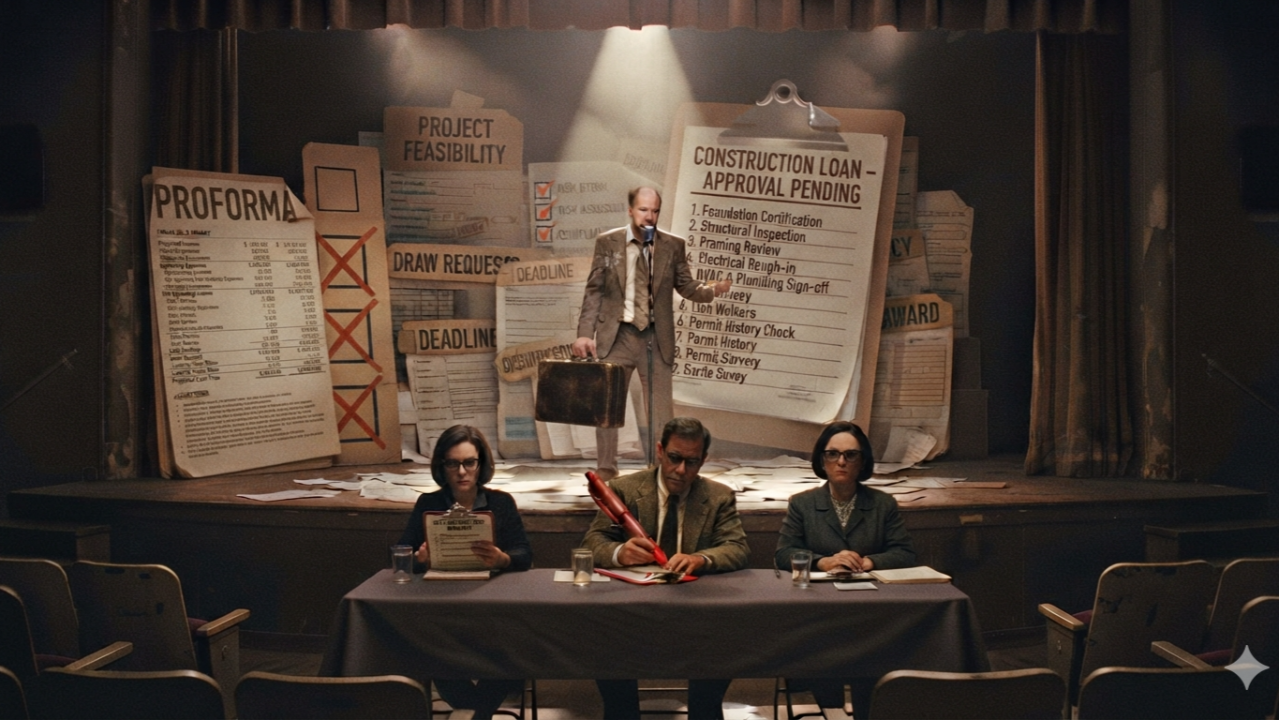
Whichever side of the deal desk you sit on, something in here is going to ruffle some feathers. Read it anyway. Sponsors will close on better terms. Lenders will close with better borrowers.
Let’s imagine for a second that you’re a sponsor of a deal that needs a loan. You got the term sheet, and now you’re at the fun part: “Needs List”, “Underwriting List”, “Underwriting Checklist”. You know, that long list of documents that was probably sent to you by some young kid sitting behind a desk who never bought, sold or built anything themselves. So what is it actually for?
- A. A full accounting of your project or investment that helps a prospective lender determine their risk, and therefore the leverage and price that they are willing to accept for that risk (oh… you thought that was already determined on the LOI? Sorry to break it to you…)
- B. A behavioral stress test of YOU
- C. A behavioral stress test of THEM
- D. All of the above
This is a Pass or Fail question. Pass, you get a smooth close. Fail, you don’t.
Of course, the answer is D. All of the above.
The diligence process is both a qualifier for the final structure and a rehearsal for the loan.
Underwriting is as much about you as it is about risk. And it’s as much about them as it is about you. Understanding this, and understanding not just what underwriters want to see but also how they want to receive that information, is almost as important (and sometimes more important) than the merits of the deal itself.
What the underwriting process tells your lender
1. Are you organized?
Does the package arrive complete and indexed, or does it trickle in across nine emails with filenames like “scan_final_v2(3)”? The file room is a preview of your draw requests, your competence (can you organize a file?) and your respect for the little guy (the analyst, the junior underwriter, the processor). Here’s a secret: more often than not, I’ve seen bad deals with good organization get better terms than good deals with bad organization.
Do your numbers tie? If the rent roll, T-12, and pro forma tell three different stories, the underwriter’s first job becomes reconciling you instead of underwriting you. Is it a lie? Is it incompetence? Is it laziness? That work gets priced.
2. Are you transparent?
Did the lien, the lawsuit, the cost overrun, the partner dispute come from you, or from the background search? Self-disclosed warts are underwriting items. Discovered warts are character findings.
One discovered omission converts every other document in the file from “accepted” to “verify independently.” That’s weeks of timeline and a permanent trust discount.
Do Not Lie.
3. Are you smart?
Can you answer the second question? Anyone can recite their own pro forma (if you can’t, then you definitely just answered this section… sorry). The tell is what happens one step down from this: why that absorption assumption, can you justify your OPEX ratio, and what breaks the exit?
Do you know your deal’s weaknesses before the underwriter names them? Do you believe it has any weaknesses? A sponsor who understands and volunteers the bear case and has an action plan for it reads as an operator and a problem solver. A sponsor who’s hearing it for the first time reads as a student in their own deal. Your lender is not your professor. Furthermore (and this is almost a universal reality) a sponsor who can get in front of any skepticism is one who can demand better terms. A sponsor who can’t is handing a lender a blank check. Reinforce the weaknesses with logical rationalization and contingency plans before they suck your wallet out through the holes they poke in your hull.
4. Are you responsive?
Turnaround on follow-ups is scored, whether anyone admits it or not (in fact, I argue in my credit matrix tool that this should be a credit box addition). Twenty-four hours reads as an operator with their arms around the project. Two weeks reads as a future servicing problem.
Silence gets interpreted, and never charitably. An unanswered question ages into an assumed problem, because the underwriter has to fill the gap with something, and they’re paid to fill it conservatively. Blank = bad.
When I underwrote files for a national construction lender, we had a saying: “If it’s not there, assume the worst” (this almost always applied to personal financial statements. For God’s sake. Send it). Now, there may be some things that can be weaved in as trust and process are built. For example, you don’t need to disclose on day 1 that 7 months ago you had a sub lien the property, sue you, and then the case got dismissed due to sub fraud. You do need to disclose if there is an ongoing major issue (like a case), and what you’re doing about it. Something that deserves an LOE (letter of explanation) or could be a binary deal killer is not something you should waste days, weeks or months of everyone’s time hiding.
5. Are you easy to work with?
When asked for something inconvenient, do you send it or litigate the request? Every negotiated document request is logged as a preview of covenant compliance conversations to come.
Do you treat the analyst as well as the MD? Underwriters compare notes. The sponsor who’s charming up and abrasive down gets written up, informally, in every credit discussion.
To the hard hitters who have been successful at plowing their way through deals with brash and cunning: yes, you’re loud, and scary, and smart. But that timidness or silence from that green analyst or originator on the other end of the line isn’t fear. It’s resentment brewing. And I assure you that gets priced in without a paper trail. Don’t be a dick.
If the answer to any of these is no, your otherwise good deal loses points. Er… I should say, probably gains points (in cost).
Everything above is really one question:
The underwriter is extrapolating from your best behavior to your behavior under stress, and the discount rate on that extrapolation is steep.
Retrades on leverage, price and covenants are unfortunately almost a given on any LOI that is a TBD (hint: they all are). Any seasoned operator knows and bemoans this.
Now. Of course retrading is not just a you problem. In the multi-trillion dollar RE lending industry, there is sadly a broad spectrum of business ethics, and where your lender sits on the “do what you say you’ll do” spectrum will determine if they treat retrading as a fee and yield extraction game (bad), or a reactive, fiduciary responsibility to their investors (fair).
What the underwriting process tells YOU about your lender
Speed and rhythm
How long from package delivery to first substantive follow-up? A desk that takes three weeks to open your file may also take three weeks to fund your draws. Yes, these are different departments, but response times should trickle down from leadership.
Are follow-up requests batched and organized, or do they arrive one at a time, drip-fed? Drip-fed questions usually mean nobody senior has actually read the file yet, unless they’re milking the behavioral stress test and/or slow-playing you until another loan pays off, which is a whole other issue.
Are the same questions being asked multiple times? If so, either they think you’re a liar (which you should probably address) or, more likely, they are not synced internally.
Probing that stops being underwriting
“What’s your total profit on this deal?” asked before terms are set, with no connection to sizing or cushion, isn’t risk analysis. It’s a fee calibration exercise or, worse, they’re already thinking beyond foreclosure. Legitimate lenders ask about margin to confirm you can absorb stress. Extractive lenders ask about margin to see how much of it is available for capture. Pay very careful attention to how this question, which itself can indeed be legitimate, is asked.
Watch for interest in your upside instead of your downside. An underwriter’s job is the left tail: what happens if costs run, sales slow, rates move. When the questions keep drifting to the right tail (your exit, your promote, your equity multiple), you’re not being underwritten. You’re being appraised (and yes, that’s meant to sound ominous).
Questions about your alternatives are a tell: “Who else are you talking to?” or “How quickly do you need to close?” early in diligence measure your leverage, not your credit. These are common, innocuous questions in their own right (and especially common of an eager young originator), but the lender who knows you have no fallback and a hard deadline also knows exactly when the retrade can arrive and how much it can take, so consider how you respond to this. Transparency in your process doesn’t have to mean showing your entire deck.
Requests for information with no underwriting purpose: your basis in other unrelated projects, your liquidity beyond the guaranty analysis, what you paid for the land years ago when it doesn’t bear on current value. Information asymmetry is negotiating power. Some desks collect it for the file. Some collect it for the closing table.
Quality of the questions
Are the questions specific to your deal, or generic list recycling? A lender who asks about your takedown schedule read the file. A lender who asks for documents you already sent did not.
Do questions get smarter as the process goes, or do they reset every call? Repeated questions mean turnover on the deal team, incompetence, or senior decision makers haven’t yet engaged.
Who shows up
Have you spoken to the actual credit decision-maker, or only the salesperson who issued the LOI? If credit never appears before the retrade does, the LOI was probably bait, and this could be a signal that they are in the extraction game.
Does the originator’s story match the underwriter’s questions? Daylight between the two means the deal was sold internally on different terms than you were quoted.
How they handle bad news
When diligence surfaces a wart, do they call to discuss it, or does a revised term sheet just show up? The first is a lender working the problem. The second is a repricing machine.
When terms move, is the explanation specific (name the finding, name the impact), or vague (“committee got uncomfortable”)? Specific explanations can be negotiated. Vague ones are extraction.
Structural tells
Is the deposit refundable, and against what milestones? Nonrefundable deposits paired with slow diligence is the fee-harvest business model in its purest form. Fortunately, this has become increasingly rare due to litigation catching up to the game, but it still happens. Keep an eye on the fine print, and make sure your deposit is refundable sans actual expenses (appraisals, third-party reports, etc).
Did the term sheet leave key items “TBD in documentation” or not addressed (covenants, reserves, guaranty scope)? Every TBD or omission of key features in the term sheet is a pre-authorized retrade.
Ask what percentage of their issued term sheets close on original terms. They won’t have the exact number. They probably won’t tell you even if they do (nor should you expect them to). How they react to the question tells you more.
Track record
Get borrower and advisor (if you trust them) references from deals that closed and one that didn’t. How a lender behaves when walking away is the cleanest read on the spectrum described above. But careful here in discerning between standard gripes and actual red flags (which this section addresses).
Where does the money actually come from: discretionary fund, warehouse line, syndication after signing? A lender who has to go find your money after the LOI isn’t retrading you by choice; they’re passing through someone else’s terms. This is a common model. Many lenders JV (participate with other lenders on a note) or table fund (they write terms then go find the note buyer, usually from a relationship pool), but they should be transparent about their process and the range of terms they can pool from.
Major takeaways
OK. So here are the takeaways. The LOI is a draft, organization often pays more than quality, disclose before discovery (and if something isn’t disclosed, the worst is assumed), reinforce weaknesses with pre-emptive answers and contingencies, underwriters are always extrapolating (whether they know it or not), protect your leverage, listen to how the questions are asked and answered, and don’t be a dick.
Happy closings.