Effective Graphics: Months of Underwriting in One Image
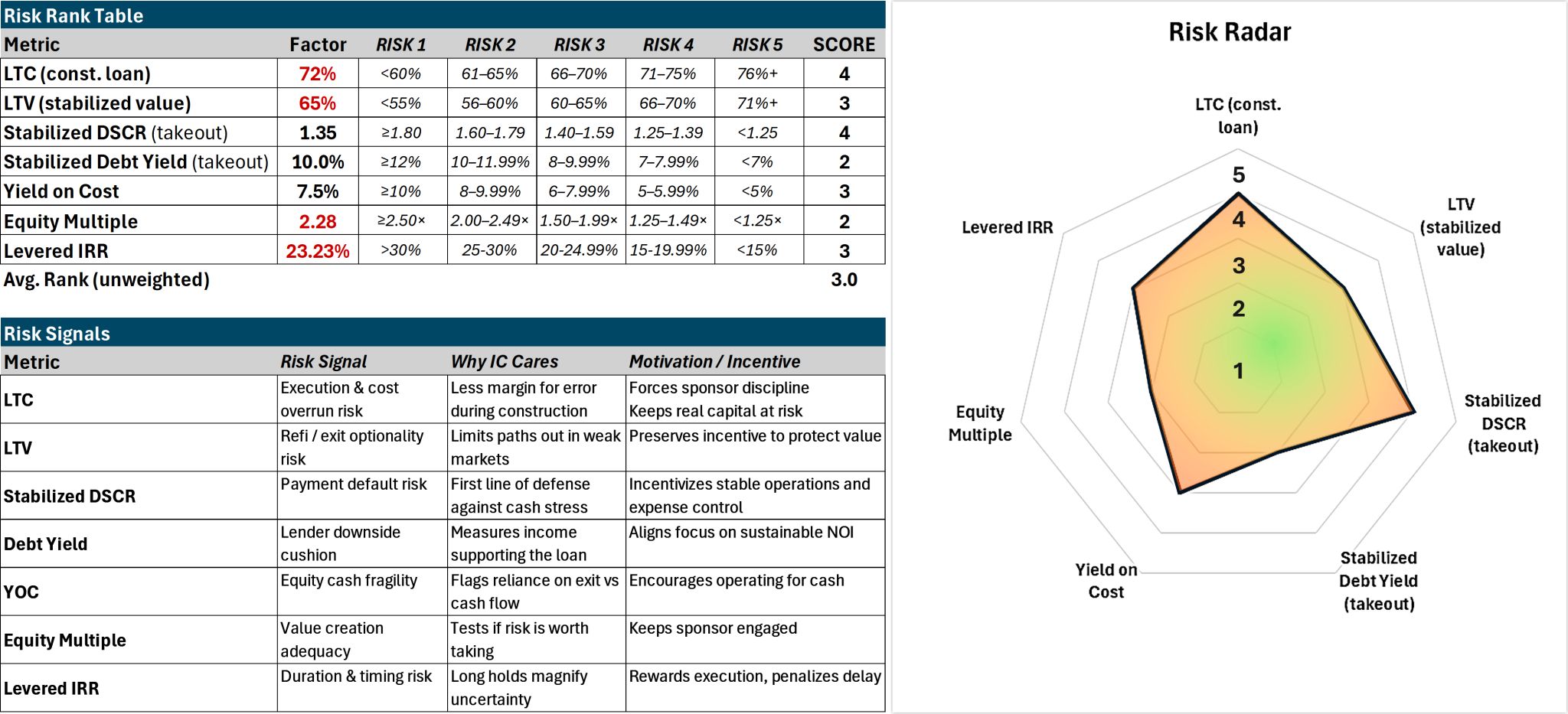
Effective graphics are more than aesthetic. Here is several months of construction loan underwriting distilled into one image — courtesy of a project I'm structuring (and still shaping… so don't put much weight on the actuals).
Investment committees should be doing this in some form or fashion.
The good ones already do, but it often takes months of proforma re-writes (Proforma Version 2.33, anyone?), memos, re-trades, sensitivity tables, and circular debate to finally land on these conclusions:
Where does risk actually sit, are performance metrics (Debt Yield, DSCRs, ROAC, etc.) commensurate, and how much confidence can be extracted from operator incentives?
By forcing leverage, coverage, yield, and equity outcomes onto a common or weighted risk scale (already done up-front in any good credit mandate leverage and pricing model, which in turn can be used to shape risk output buckets), it makes risk concentration and performance motivation visible immediately and exposes awkward cases where "fine on paper" really means "fragile IRL." It also helps surface areas of concern, misalignments and glaring errors early.
Risk isn't precise, but in most cases CAN be bounded and tested.
So what actually comes through in this snapshot? Let's assume the proforma and budget are already properly vetted, scheduled and comped (they are). The risk profile is coherent and internally consistent, which is the first hurdle. More importantly, the shape of the risk matches the asset. This is a front-loaded (new construction), operations-heavy, specialty lease type with a longer stabilization curve. Nothing here trips the "this doesn't make sense" alarm, but it does appear to edge high on the optimism scale.
Where an IC should really overweight stress here isn't macro assumptions or exit pricing, but operations over time. Not just whether the team can execute on construction, but whether they can execute consistently during lease-up and when stabilized without fatigue, slippage, or erosion in performance. That's why this framework is useful for me as an advisor. It gives me a clean way to tell the client where to focus and where to concede.
In a deal like this, modestly padding OPEX, being realistic on management costs, or slightly down-scaling lease or occupancy assumptions would only increase credibility, preserve incentive alignment mid-cycle, and reduce risk that operational misses compound into real problems later. This deal doesn't need value-cost engineering. It needs more operational slack and a realistically achievable, defensible business plan for lease-up and operations.